
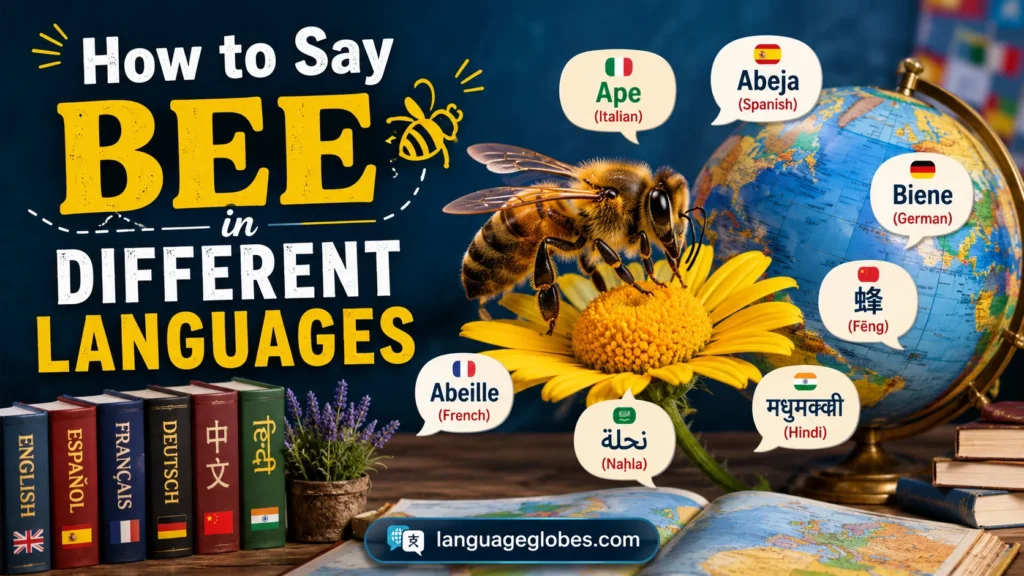
Learning how to say bee in different languages opens a window into linguistic diversity and global cultures. This bee translation guide explores the word for bee across languages while showing connections between people and nature. Bees are an essential insect that support pollination, honey production, and growth of plants, flowers, fruits, and vegetables.
These fascinating creatures reveal how important insects influence Earth and help ecosystems thrive through nature. Readers can explore cultural characteristics, regions, and local traditions through this comprehensive guide about bee names. Whether you are a student, traveler, or language enthusiast, these translations create meaningful learning experiences.
Discovering bee stories from various countries also highlights environmental importance and human connections. This article includes more than 70 languages, regional information, and examples of pronunciation for curious learners.
You can compare unique pronunciations, expressions, and translations while building stronger language skills. Learning bee words can inspire explore cultures, understand diverse backgrounds, and appreciate linguistic variation worldwide. From honeybee facts to wildlife awareness, this topic celebrates the bond between humans and nature.
Also Read This: How to Say Beach in Different Languages
Interesting Facts About Bee
- Bees are responsible for pollinating around one-third of the food humans consume.
- There are more than 20,000 known species of bees worldwide.
- Honey bees communicate through a special movement called the “waggle dance.”
- Bees can recognize patterns, colors, and even human faces.
- A single honey bee produces only a tiny amount of honey during its lifetime.
- Bees are found on every continent except Antarctica.
- Ancient civilizations considered bees symbols of hard work, community, and prosperity.
- Many languages have unique words and idioms inspired by bees.
- Bees contribute billions of dollars to global agriculture every year.
- Learning the word “bee” in different languages helps build cultural awareness and vocabulary.
How to Say Bee in Different Languages
The word “bee” varies greatly from one language to another. Some languages have similar words due to shared linguistic roots, while others use completely unique terms. Below, you will find translations organized by region for easy learning and comparison.
European Languages
Europe is home to many of the world’s most widely spoken languages. From the Romance languages of Southern Europe to the Germanic and Slavic languages of the north and east, the continent offers incredible linguistic diversity. The word for bee often reflects centuries of cultural and historical development.
| Language | Country/Region | Translation | Pronunciation | Example Sentence |
| 🇺🇸 American English | USA | Bee | Bee | The bee is collecting nectar. |
| 🇬🇧 British English | UK | Bee | Bee | The bee is flying near the flowers. |
| 🇦🇺 Australian English | Australia | Bee | Bee | A bee landed on the flower. |
| French | 🇫🇷 France | Abeille | Ah-bay | L’abeille vole dans le jardin. |
| Spanish | 🇪🇸 Spain | Abeja | Ah-beh-ha | La abeja está en la flor. |
| Portuguese | 🇵🇹 Portugal | Abelha | Ah-bell-ya | A abelha está voando. |
| Italian | 🇮🇹 Italy | Ape | Ah-pay | L’ape è sul fiore. |
| German | 🇩🇪 Germany | Biene | Bee-neh | Die Biene fliegt. |
| Dutch | 🇳🇱 Netherlands | Bij | Bai | De bij zit op de bloem. |
| Swedish | 🇸🇪 Sweden | Bi | Bee | Biet flyger över blomman. |
| Norwegian | 🇳🇴 Norway | Bi | Bee | Bien flyr rundt blomsten. |
| Danish | 🇩🇰 Denmark | Bi | Bee | Bien flyver over blomsten. |
| Finnish | 🇫🇮 Finland | Mehiläinen | Meh-hee-lai-nen | Mehiläinen lentää. |
| Icelandic | 🇮🇸 Iceland | Býfluga | Bee-flu-ga | Býflugan flýgur. |
| Polish | 🇵🇱 Poland | Pszczoła | Psh-cho-wa | Pszczoła lata wokół kwiatów. |
| Czech | 🇨🇿 Czech Republic | Včela | V-che-la | Včela létá kolem květin. |
| Slovak | 🇸🇰 Slovakia | Včela | V-che-la | Včela je na kvete. |
| Hungarian | 🇭🇺 Hungary | Méh | Mayh | A méh a virágon van. |
| Romanian | 🇷🇴 Romania | Albină | Al-bee-na | Albina zboară. |
| Greek | 🇬🇷 Greece | Μέλισσα | Me-lee-sa | Η μέλισσα πετάει. |
| Russian | 🇷🇺 Russia | Пчела | Pche-la | Пчела летает. |
| Ukrainian | 🇺🇦 Ukraine | Бджола | B-jola | Бджола літає. |
| Bulgarian | 🇧🇬 Bulgaria | Пчела | Pche-la | Пчелата лети. |
| Serbian | 🇷🇸 Serbia | Пчела | Pche-la | Пчела лети око цвећа. |
| Croatian | 🇭🇷 Croatia | Pčela | Pche-la | Pčela leti. |
Asian Languages
Asia is the largest continent and contains thousands of languages and dialects. From East Asia to South Asia and Southeast Asia, bees hold importance in agriculture, folklore, and daily life. The words used for bee often reveal fascinating linguistic traditions.
| Language | Country/Region | Translation | Pronunciation | Example Sentence |
| Chinese (Mandarin) | 🇨🇳 China | 蜜蜂 | Mee-fung | 蜜蜂在花上。 |
| Japanese | 🇯🇵 Japan | 蜂 | Hachi | 蜂が飛んでいます。 |
| Korean | 🇰🇷 South Korea | 벌 | Beol | 벌이 꽃에 앉아 있습니다. |
| Hindi | 🇮🇳 India | मधुमक्खी | Ma-dhu-mak-khee | मधुमक्खी फूल पर है। |
| Urdu | 🇵🇰 Pakistan | شہد کی مکھی | Shehad Ki Makhi | شہد کی مکھی پھول پر بیٹھی ہے۔ |
| Bengali | 🇧🇩 Bangladesh | মৌমাছি | Mou-ma-chi | মৌমাছি উড়ছে। |
| Punjabi | India/Pakistan | ਮੱਖੀ | Makhi | ਮੱਖੀ ਫੁੱਲ ਤੇ ਹੈ। |
| Gujarati | 🇮🇳 India | મધમાખી | Madhmakhi | મધમાખી ફૂલ પર છે. |
| Marathi | 🇮🇳 India | मधमाशी | Madhmashi | मधमाशी उडत आहे. |
| Tamil | 🇮🇳 India | தேனீ | They-nee | தேனீ பறக்கிறது. |
| Telugu | 🇮🇳 India | తేనెటీగ | Thene-teega | తేనెటీగ ఎగురుతోంది. |
| Kannada | 🇮🇳 India | ಜೇನುನೊಣ | Jenu-nona | ಜೇನುನೊಣ ಹಾರುತ್ತಿದೆ. |
| Malayalam | 🇮🇳 India | തേനീച്ച | They-nee-cha | തേനീച്ച പറക്കുന്നു. |
| Sinhala | 🇱🇰 Sri Lanka | මී මැස්සා | Mee-messa | මී මැස්සා පියාසර කරයි. |
| Nepali | 🇳🇵 Nepal | मौरी | Mau-ri | मौरी फूलमा छ। |
| Thai | 🇹🇭 Thailand | ผึ้ง | Pheung | ผึ้งอยู่บนดอกไม้ |
| Vietnamese | 🇻🇳 Vietnam | Ong mật | Ong Mat | Ong mật đang bay. |
| Indonesian | 🇮🇩 Indonesia | Lebah | Leh-bah | Lebah terbang di taman. |
| Malay | 🇲🇾 Malaysia | Lebah | Leh-bah | Lebah berada di bunga. |
| Filipino | 🇵🇭 Philippines | Bubuyog | Bu-bu-yog | Ang bubuyog ay lumilipad. |
| Mongolian | 🇲🇳 Mongolia | Зөгий | Zoh-gee | Зөгий нисэж байна. |
| Khmer | 🇰🇭 Cambodia | ឃ្មុំ | Khmum | ឃ្មុំកំពុងហោះ។ |
African Languages
Africa is one of the most linguistically diverse regions in the world, with thousands of languages spoken across the continent. Bees are important for agriculture, honey production, and local ecosystems. Many African cultures have rich traditions connected to beekeeping and honey harvesting.
| Language | Country/Region | Translation | Pronunciation | Example Sentence |
| Swahili | 🇹🇿 Tanzania/Kenya | Nyuki | Nyoo-kee | Nyuki anaruka. |
| Zulu | 🇿🇦 South Africa | Inyosi | In-yo-see | Inyosi isendizeni. |
| Xhosa | 🇿🇦 South Africa | Inyosi | In-yo-see | Inyosi iyabhabha. |
| Afrikaans | 🇿🇦 South Africa | By | Bay | Die by vlieg. |
| Yoruba | 🇳🇬 Nigeria | Oyin | O-yin | Oyin wa lori ododo. |
| Igbo | 🇳🇬 Nigeria | Aṅụ | Ah-noo | Aṅụ nọ n’ifuru. |
| Hausa | 🇳🇬 Nigeria | Kudan Zuma | Koo-dan Zoo-ma | Kudan zuma tana tashi. |
| Amharic | 🇪🇹 Ethiopia | ንብ | Nib | ንብ ትበራለች። |
| Somali | 🇸🇴 Somalia | Shinni | Shin-nee | Shinni way duulaysaa. |
| Shona | 🇿🇼 Zimbabwe | Nyuchi | Nyoo-chee | Nyuchi iri kubhururuka. |
| Kinyarwanda | 🇷🇼 Rwanda | Inzuki | In-zoo-kee | Inzuki iri kuguruka. |
| Malagasy | 🇲🇬 Madagascar | Tantely | Tan-te-ly | Manidina ny tantely. |
Middle Eastern Languages
The Middle East has a rich linguistic heritage that includes Semitic, Turkic, and Indo-Iranian languages. Bees have been mentioned in ancient texts, religious literature, and traditional stories throughout the region. Honey and beekeeping continue to hold cultural significance today.
| Language | Country/Region | Translation | Pronunciation | Example Sentence |
| Arabic | 🌍 Middle East | نحلة | Nah-la | النحلة تطير فوق الزهرة. |
| Hebrew | 🇮🇱 Israel | דבורה | Dvo-ra | הדבורה עפה. |
| Persian (Farsi) | 🇮🇷 Iran | زنبور عسل | Zan-boor Asal | زنبور عسل پرواز میکند. |
| Turkish | 🇹🇷 Turkey | Arı | Ah-ruh | Arı çiçeğin üzerinde. |
| Kurdish | Iraq/Turkey | Mêşhingiv | Mesh-hin-giv | Mêşhingiv difire. |
| Pashto | 🇦🇫 Afghanistan | مچۍ | Ma-chee | مچۍ الوت کوي. |
| Azerbaijani | 🇦🇿 Azerbaijan | Arı | Ah-ruh | Arı uçur. |
| Armenian | 🇦🇲 Armenia | Մեղու | Megh-oo | Մեղուն թռչում է։ |
| Georgian | 🇬🇪 Georgia | ფუტკარი | Put-ka-ri | ფუტკარი დაფრინავს. |
| Tajik | 🇹🇯 Tajikistan | Занбӯри асал | Zan-boo-ri Asal | Занбӯри асал парвоз мекунад. |
Additional Languages Around the World
Languages from different parts of the world contribute to humanity’s rich cultural heritage. Learning these words broadens your understanding of how diverse societies describe the natural world and communicate everyday ideas.
| Language | Country/Region | Translation | Pronunciation | Example Sentence |
| Maori | 🇳🇿 New Zealand | Pī | Pee | Kei te rere te pī. |
| Hawaiian | 🌺 Hawaii | Nalo meli | Na-lo Me-li | Lele ka nalo meli. |
| Samoan | 🇼🇸 Samoa | Pi | Pee | Ua lele le pi. |
| Tongan | 🇹🇴 Tonga | Pi | Pee | Oku puna e pi. |
| Fijian | 🇫🇯 Fiji | Pi | Pee | E vuka tiko na pi. |
| Irish | 🇮🇪 Ireland | Beach | Byakh | Tá an bheach ag eitilt. |
| Welsh | 🏴 Wales | Gwenynen | Gwe-ne-nen | Mae’r wenynen yn hedfan. |
| Scottish Gaelic | 🏴 Scotland | Seillean | Shay-lan | Tha an seillean ag itealaich. |
| Breton | 🇫🇷 Brittany | Gwenan | Gwe-nan | Gwenan a nij. |
| Latvian | 🇱🇻 Latvia | Bite | Bee-teh | Bite lido. |
| Lithuanian | 🇱🇹 Lithuania | Bitė | Bee-teh | Bitė skrenda. |
| Estonian | 🇪🇪 Estonia | Mesilane | Meh-si-la-ne | Mesilane lendab. |
| Slovenian | 🇸🇮 Slovenia | Čebela | Che-be-la | Čebela leti. |
| Bosnian | 🇧🇦 Bosnia | Pčela | Pche-la | Pčela leti. |
| Albanian | 🇦🇱 Albania | Bletë | Ble-te | Bleta fluturon. |
FAQs
What is the word for bee in different languages?
The word for bee changes across different languages and reflects linguistic diversity around the world. This bee translation guide helps learners discover how people say bee in various languages.
How can I say bee in other languages?
You can say bee in many countries through different translations and pronunciations. Learning these words improves language skills and helps you connect with global cultures.
Why are bee translations interesting to learn?
Bee translation shows how cultural characteristics, local traditions, and linguistic variation shape the way people describe this important insect. It also helps you explore cultures through language.
How many languages include a word for bee?
This comprehensive guide covers more than 70 languages with regional information from many areas. It provides examples of how bee is expressed across major languages worldwide.
Why are bees important to nature and the environment?
Bees are an essential insect that supports pollination, honey production, and the growth of plants, flowers, fruits, and vegetables. They play a major role in nature and wildlife.
Can learning bee words help students and travelers?
Yes, learning bee words helps a student, traveler, or language enthusiast understand new cultures. These nature words also improve communication during global experiences.
Does pronunciation change for bee in different languages?
Yes, unique pronunciations and expressions vary between regions. Exploring audio pronunciation and spoken examples can make learning more effective.
What can bee words teach us about cultures?
The word bee connects with traditions, folklore, and stories from different communities. These meanings show the relationship between people and the natural world.
Why should we learn about honeybees and insects?
Learning about bees helps people understand honeybee behavior, insect species, and the importance of protecting ecosystem balance. These fascinating creatures support life on Earth.
Where can I find bee names grouped by region?
You can find bee names grouped by region with regional information, translations, and examples from various global cultures. This makes exploring insect vocabulary easier for learners.
Conclusion
Exploring how to say bee in different languages reveals the beauty of linguistic diversity and global cultures. This bee translation journey helps learners discover the word for bee, unique pronunciations, and meaningful connections across countries. Understanding these important insects also highlights their role in pollination, honey production, and protecting nature. Whether you are a student, traveler, or language enthusiast, learning these translations builds appreciation for diverse backgrounds and the fascinating relationship between people and the natural world.

James Anderson is a passionate language enthusiast and content creator at LanguageGlobes. With a keen interest in global cultures and communication, he shares insightful and engaging content to help readers explore and master new languages.