Language is a powerful language and communication tool that conveys thoughts and emotions worldwide. It reflects the true essence of how humans express meaning across cultures. This system conveys thoughts and emotions while shaping cultural richness and global diversity. It connects human societies across the globe through shared understanding. Language also acts as a foundation for meaningful interaction and expression among people everywhere. It remains one of the most essential human tools for connection and expression.
It represents the essence of cultural richness and diversity across human societies globally. A linguistic journey reveals how word language exists in various tongues worldwide. It includes widely spoken languages and less commonly heard languages in native regions. Each system acts as a window into values, history, and worldview perspective. Human languages carry a strong unifying power that helps connect people across different backgrounds and preserve culture. This foundation builds identity, strengthens understanding, and supports meaningful global interaction.
Translation bridges global cultures and enhances knowledge during international travel and understanding. Studying foreign language increases appreciation of world diversity across continents and evolved languages. All languages share same purpose bringing people together with pronunciation guide and seventy languages. Examples across world languages include Arabic, Urdu, Lugha, لغة, Zaban, زبان with cultural contexts. Translation root system connects Arabic language and Urdu language with audio pronunciation examples. Pronunciation audio features male voice actor and female voice actor for professional listening experience.
Also read this: How to Say Hello in Different Languages
Interesting Facts About Language
- There are more than 7,000 spoken languages worldwide.
- Mandarin Chinese has the highest number of native speakers.
- English is one of the most widely used international languages.
- Some languages use alphabets, while others use symbols or characters.
- Many countries have more than one official language.
- Language helps preserve cultural identity and traditions.
- New words are added to languages every year.
- Sign languages are complete languages with their own grammar systems.
- Some endangered languages have only a few speakers remaining.
- Learning multiple languages can improve memory and cognitive skills.
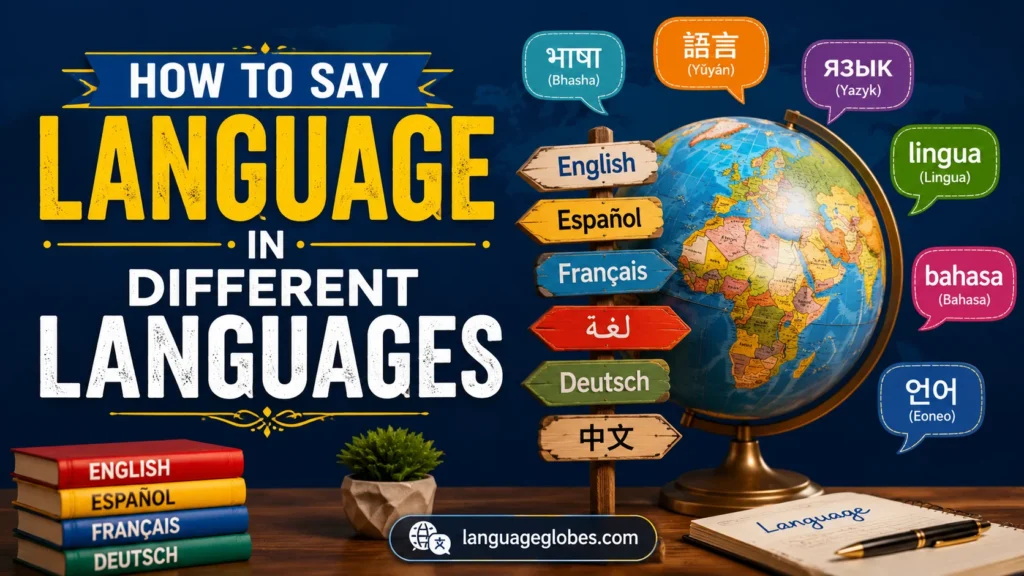
How to Say Language in Different Languages
The tables below show how to say “language” in many languages spoken around the world.
European Languages
Europe is home to many of the world’s most influential language families, including Germanic, Romance, and Slavic languages. These languages have shaped literature, science, diplomacy, and global communication for centuries. Learning European language terms can help travelers and language enthusiasts communicate more effectively across the continent.
| Language | Country/Region | Translation | Pronunciation | Example Sentence |
| 🇺🇸 American English | United States | Language | LANG-gwij | Language helps people communicate. |
| 🇬🇧 British English | United Kingdom | Language | LANG-gwij | Learning a language is rewarding. |
| 🇦🇺 Australian English | Australia | Language | LANG-gwij | English is a global language. |
| French | 🇫🇷 France | Langue | Lahng | Cette langue est belle. |
| Spanish | 🇪🇸 Spain | Idioma | Ee-dee-O-ma | Este idioma es importante. |
| Portuguese | 🇵🇹 Portugal | Língua | LEEN-gwa | Esta língua é interessante. |
| Italian | 🇮🇹 Italy | Lingua | LEEN-gwa | Questa lingua è facile. |
| German | 🇩🇪 Germany | Sprache | SHPRA-khe | Die Sprache ist schön. |
| Dutch | 🇳🇱 Netherlands | Taal | Tahl | Deze taal is nuttig. |
| Swedish | 🇸🇪 Sweden | Språk | Sproke | Detta språk är viktigt. |
| Norwegian | 🇳🇴 Norway | Språk | Sproke | Dette språket er flott. |
| Danish | 🇩🇰 Denmark | Sprog | Sproh | Dette sprog er interessant. |
| Finnish | 🇫🇮 Finland | Kieli | Kee-eh-lee | Tämä kieli on kaunis. |
| Icelandic | 🇮🇸 Iceland | Tungumál | Toon-gu-mal | Þetta tungumál er gott. |
| Polish | 🇵🇱 Poland | Język | YEN-zik | Ten język jest piękny. |
| Czech | 🇨🇿 Czech Republic | Jazyk | Yah-zik | Tento jazyk je krásný. |
| Slovak | 🇸🇰 Slovakia | Jazyk | Yah-zik | Tento jazyk je zaujímavý. |
| Hungarian | 🇭🇺 Hungary | Nyelv | Nyelv | Ez a nyelv szép. |
| Romanian | 🇷🇴 Romania | Limbă | LEEM-buh | Această limbă este frumoasă. |
| Bulgarian | 🇧🇬 Bulgaria | Език | Eh-zik | Този език е хубав. |
| Croatian | 🇭🇷 Croatia | Jezik | Yeh-zik | Ovaj jezik je lijep. |
| Serbian | 🇷🇸 Serbia | Jezik | Yeh-zik | Ovaj jezik je važan. |
| Slovenian | 🇸🇮 Slovenia | Jezik | Yeh-zik | Ta jezik je lep. |
| Greek | 🇬🇷 Greece | Γλώσσα | GLO-sa | Αυτή η γλώσσα είναι όμορφη. |
| Russian | 🇷🇺 Russia | Язык | Ya-zik | Этот язык красивый. |
| Ukrainian | 🇺🇦 Ukraine | Мова | MO-va | Ця мова гарна. |
Asian Languages
Asia is the largest and most linguistically diverse continent in the world. From the character-based writing systems of East Asia to the rich linguistic traditions of South and Southeast Asia, the region contains hundreds of languages spoken by billions of people.
| Language | Country/Region | Translation | Pronunciation | Example Sentence |
| Chinese (Mandarin) | 🇨🇳 China | 语言 | Yu-yan | 这个语言很有趣。 |
| Cantonese | Hong Kong | 語言 | Yu-yin | 呢個語言好有趣。 |
| Japanese | 🇯🇵 Japan | 言語 | Gen-go | この言語は面白いです。 |
| Korean | 🇰🇷 South Korea | 언어 | Eon-eo | 이 언어는 아름답습니다. |
| Hindi | 🇮🇳 India | भाषा | Bha-sha | यह भाषा सुंदर है। |
| Urdu | 🇵🇰 Pakistan | زبان | Za-baan | یہ زبان خوبصورت ہے۔ |
| Bengali | 🇧🇩 Bangladesh | ভাষা | Bha-sha | এই ভাষা সুন্দর। |
| Punjabi | India/Pakistan | ਭਾਸ਼ਾ | Bha-sha | ਇਹ ਭਾਸ਼ਾ ਸੋਹਣੀ ਹੈ। |
| Gujarati | India | ભાષા | Bha-sha | આ ભાષા સુંદર છે. |
| Marathi | India | भाषा | Bha-sha | ही भाषा सुंदर आहे. |
| Tamil | India/Sri Lanka | மொழி | Mo-zhi | இந்த மொழி அழகானது. |
| Telugu | India | భాష | Bha-sha | ఈ భాష అందమైనది. |
| Kannada | India | ಭಾಷೆ | Bha-she | ಈ ಭಾಷೆ ಸುಂದರವಾಗಿದೆ. |
| Malayalam | India | ഭാഷ | Bha-sha | ഈ ഭാഷ മനോഹരമാണ്. |
| Sinhala | 🇱🇰 Sri Lanka | භාෂාව | Bha-sha-va | මෙම භාෂාව ලස්සනයි. |
| Nepali | 🇳🇵 Nepal | भाषा | Bha-sha | यो भाषा राम्रो छ। |
| Thai | 🇹🇭 Thailand | ภาษา | Pha-sa | ภาษานี้สวยงาม |
| Vietnamese | 🇻🇳 Vietnam | Ngôn ngữ | Ngon Ngu | Ngôn ngữ này rất hay. |
| Indonesian | 🇮🇩 Indonesia | Bahasa | Ba-ha-sa | Bahasa ini menarik. |
| Malay | 🇲🇾 Malaysia | Bahasa | Ba-ha-sa | Bahasa ini penting. |
| Filipino | 🇵🇭 Philippines | Wika | Wee-ka | Magandang wika ito. |
| Mongolian | 🇲🇳 Mongolia | Хэл | Khel | Энэ хэл сайхан. |
| Khmer | 🇰🇭 Cambodia | ភាសា | Phea-sa | ភាសានេះស្អាត។ |
| Lao | 🇱🇦 Laos | ພາສາ | Pha-sa | ພາສານີ້ດີ. |
| Burmese | 🇲🇲 Myanmar | ဘာသာစကား | Ba-tha-za-ga | ဒီဘာသာစကားကလှတယ်။ |
African Languages
Africa is one of the most linguistically rich regions on Earth, with thousands of languages spoken across the continent. These languages reflect diverse cultures, traditions, and histories that have been preserved for generations.
| Language | Country/Region | Translation | Pronunciation | Example Sentence |
| Swahili | East Africa | Lugha | Loo-gha | Lugha hii ni nzuri. |
| Zulu | 🇿🇦 South Africa | Ulimi | Oo-lee-mee | Ulimi luhle. |
| Xhosa | South Africa | Ulwimi | Ool-wee-mee | Ulwimi luhle. |
| Afrikaans | South Africa | Taal | Tahl | Hierdie taal is mooi. |
| Yoruba | 🇳🇬 Nigeria | Ede | Eh-deh | Ede yii dara. |
| Igbo | Nigeria | Asụsụ | Ah-soo-soo | Asụsụ a mara mma. |
| Hausa | Nigeria | Harshe | Har-she | Wannan harshe yana da kyau. |
| Amharic | 🇪🇹 Ethiopia | ቋንቋ | Kwan-kwa | ይህ ቋንቋ ቆንጆ ነው። |
| Somali | 🇸🇴 Somalia | Luuqad | Loo-qad | Luuqaddu waa qurux badan. |
| Shona | 🇿🇼 Zimbabwe | Mutauro | Moo-ta-u-ro | Mutauro uyu wakanaka. |
| Kinyarwanda | 🇷🇼 Rwanda | Ururimi | Oo-roo-ree-mee | Ururimi rwiza. |
| Oromo | Ethiopia | Afaan | A-faan | Afaan kun gaarii dha. |
Middle Eastern Languages
The Middle East has played a major role in the development of civilization, trade, literature, and religion. Languages from this region have influenced cultures across Asia, Europe, and Africa and continue to be spoken by millions of people today.
| Language | Country/Region | Translation | Pronunciation | Example Sentence |
| Arabic | Middle East | لغة | Lu-gha | هذه لغة جميلة. |
| Persian (Farsi) | 🇮🇷 Iran | زبان | Za-baan | این زبان زیبا است. |
| Turkish | 🇹🇷 Türkiye | Dil | Deel | Bu dil güzel. |
| Hebrew | 🇮🇱 Israel | שפה | Sa-fa | השפה הזאת יפה. |
| Kurdish | Kurdistan Region | Ziman | Zee-man | Ev ziman xweşe. |
| Azerbaijani | 🇦🇿 Azerbaijan | Dil | Deel | Bu dil gözəldir. |
| Armenian | 🇦🇲 Armenia | Լեզու | Le-zoo | Այս լեզուն գեղեցիկ է։ |
| Georgian | 🇬🇪 Georgia | ენა | Eh-na | ეს ენა ლამაზია. |
Additional Languages Around the World
Beyond the major regions above, many fascinating languages are spoken throughout the Americas and Oceania. These languages contribute to the rich diversity of human communication and cultural expression.
| Language | Country/Region | Translation | Pronunciation | Example Sentence |
| Hawaiian | Hawaii | ʻŌlelo | Oh-leh-lo | He nani kēia ʻōlelo. |
| Māori | 🇳🇿 New Zealand | Reo | Reh-o | He reo ataahua tenei. |
| Samoan | Samoa | Gagana | Nga-ngana | E manaia lenei gagana. |
| Tongan | Tonga | Lea | Leh-ah | Ko e lea lelei eni. |
| Tahitian | Tahiti | Reo | Reh-o | E reo maitai teie. |
| Fijian | Fiji | Vosa | Vo-sa | E vinaka na vosa oqo. |
| Inuit (Inuktitut) | Arctic Canada | Uqausiq | Oo-kau-sik | Uqausiq taanna kusanarpoq. |
| Cherokee | United States | ᎦᏬᏂᎯᏍᏗ | Ga-wo-ni-hi-sdi | ᎦᏬᏂᎯᏍᏗ ᎤᏬᏚᎯ. |
| Navajo | United States | Bizaad | Bee-zad | Diné bizaad yá’át’ééh. |
| Quechua | Peru | Simi | See-mee | Kay simi sumaqmi. |
| Aymara | Bolivia | Aru | Ah-roo | Aka aru waliwa. |
| Guarani | Paraguay | Ñe’ẽ | Nye-eh | Ko ñe’ẽ porã. |
FAQs
What is the meaning of language in global communication?
Language is a powerful communication tool that conveys thoughts and emotions across cultures. It reflects the true essence of human expression and shared understanding. It also represents cultural richness and diversity within human societies across the globe.
How does language work as a communication tool?
Language functions as a natural tool that conveys thoughts and emotions between people. It strengthens communication skills and supports human connection across different backgrounds. It is a powerful tool that helps humans share meaning effectively.
How does language reflect cultural richness and diversity?
Language represents cultural richness and world diversity across human societies. It reflects identity, values, and worldview perspective of different communities. This diversity shows how humans developed unique ways of expression.
What is a linguistic journey across global cultures?
A linguistic journey explores how word language appears in various tongues worldwide. It includes widely spoken languages and less commonly heard languages in native regions. This journey reveals how people connect through expression and meaning.
What is the difference between widely spoken and less commonly heard languages?
Widely spoken languages are used across continents, while less commonly heard languages exist in smaller communities. Both reflect cultural diversity and linguistic heritage of human languages. Each plays an important role in global understanding.
How does language preserve culture and identity?
Language helps preserve culture and strengthen cultural identity through shared stories and traditions. It carries history, values, and oral tradition across generations. This connection supports understanding of worldview and human experience.
How does translation support global communication and travel?
Translation improves global communication and helps international travel and understanding. It connects foreign language speakers and builds intercultural communication. It also supports learning and appreciation of different cultures.
What are examples of different languages and pronunciation systems?
Examples include Arabic, Urdu, Lugha, لغة, and Zaban, showing linguistic variety. Arabic language and Urdu language demonstrate unique writing systems and pronunciation guide features. These systems help learners understand global speech patterns.
What is multilingualism and why is it important?
Multilingualism allows people to communicate in multiple languages across cultures. It enhances global communication networks and improves language learning abilities. It also increases cultural exchange and understanding among diverse communities.
How does language connect people across the world?
Language builds a strong communication bridge that connects people globally. It carries unifying power that brings different backgrounds together. This connection promotes understanding, cooperation, and shared human experience.
Conclusion
In conclusion, language is the most powerful communication tool that conveys thoughts and emotions across global human societies. It reflects true cultural richness, diversity, and the shared essence of human expression across the globe. Through every linguistic journey, people experience connection, identity, and a deeper worldview perspective that strengthens understanding. This natural powerful tool continues to connect people, preserve culture, and support meaningful global interaction. Ultimately, language remains the key window into human history, identity, and unity.

Lucy Carter is a curious mind and language lover who writes for Language Globes. She enjoys discovering new languages and sharing simple, helpful ideas that make learning fun and accessible for everyone.