
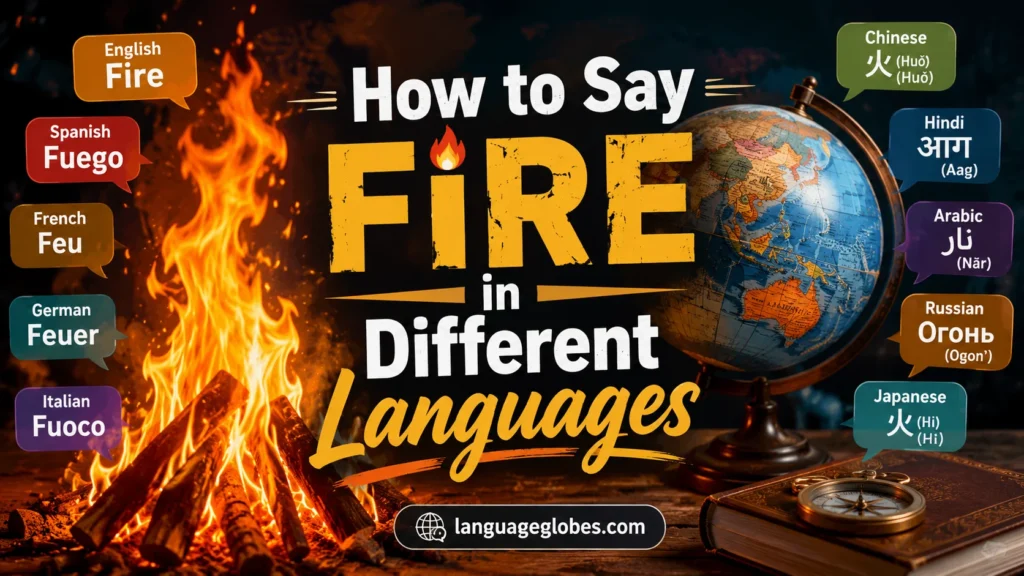
Across cultures and continents, the word fire has shaped humanity since time immemorial. It represents a primal force and elemental phenomenon seen in physical flames and flames. In every linguistic hearth, languages transform its meaning through translation for global understanding. This guide explores 70 languages, offering list of translations with clear pronunciations. From romance languages and Latin roots like ignis and flamma, origins emerge. Dictionaries reveal word origin, linking etymology to myths, religious texts, and literature.
The concept of fire symbolizes passion, energy, strength, and transformation for travelers. Students, writers, and language learners explore global cultures and cultural diversity. From campfires to indigenous communities, and the Olympic flame, usage spans contexts. It appears in modern scientific discussions as a universal concept across regions. The topic helps explain how to say fire in different languages. It also supports learning through clear examples and cultural insights.
Also read this: How to Say Grandma in Different Languages
Interesting Facts About Fire
- Fire has been used by humans for hundreds of thousands of years.
- Many ancient civilizations considered fire a sacred element.
- Fire symbolizes energy, passion, courage, and transformation in many cultures.
- The Olympic flame is an international symbol of peace and unity.
- Fire is one of the four classical elements in many philosophical traditions.
- Different languages often use fire metaphorically to describe strong emotions.
- Fire plays an important role in festivals and celebrations worldwide.
- Learning the word fire in different languages helps improve cultural awareness and vocabulary.
How to Say Fire in Different Languages
European Languages
Europe is home to hundreds of languages and rich cultural traditions. Many European languages belong to the Indo-European language family, while others have unique linguistic roots. The word for fire often reflects centuries of history, mythology, and daily life across the continent.
| Language | Country/Region | Translation | Pronunciation | Example Sentence |
| 🇺🇸 American English | USA | Fire | FYE-er | The fire is burning brightly. |
| 🇬🇧 British English | United Kingdom | Fire | FYE-uh | The fire keeps us warm. |
| 🇦🇺 Australian English | Australia | Fire | FYE-ah | We sat around the fire. |
| Spanish | 🇪🇸 Spain | Fuego | FWEH-go | El fuego está caliente. |
| French | 🇫🇷 France | Feu | Fuh | Le feu brûle. |
| German | 🇩🇪 Germany | Feuer | FOY-er | Das Feuer ist groß. |
| Italian | 🇮🇹 Italy | Fuoco | FWO-ko | Il fuoco è caldo. |
| Portuguese | 🇵🇹 Portugal | Fogo | FO-go | O fogo está aceso. |
| Dutch | 🇳🇱 Netherlands | Vuur | VUUR | Het vuur brandt. |
| Swedish | 🇸🇪 Sweden | Eld | ELD | Elden är varm. |
| Norwegian | 🇳🇴 Norway | Ild | ILD | Ilden brenner. |
| Danish | 🇩🇰 Denmark | Ild | ILD | Ilden er varm. |
| Finnish | 🇫🇮 Finland | Tuli | TOO-lee | Tuli palaa. |
| Icelandic | 🇮🇸 Iceland | Eldur | EL-dur | Eldurinn logar. |
| Polish | 🇵🇱 Poland | Ogień | O-gyen | Ogień jest gorący. |
| Czech | 🇨🇿 Czech Republic | Oheň | O-hen | Oheň hoří. |
| Slovak | 🇸🇰 Slovakia | Oheň | O-hen | Oheň je horúci. |
| Hungarian | 🇭🇺 Hungary | Tűz | TOOZ | A tűz ég. |
| Romanian | 🇷🇴 Romania | Foc | FOK | Focul arde. |
| Greek | 🇬🇷 Greece | Φωτιά | Fo-tya | Η φωτιά καίει. |
| Russian | 🇷🇺 Russia | Огонь | A-gon | Огонь горит. |
| Ukrainian | 🇺🇦 Ukraine | Вогонь | Vo-hon | Вогонь горить. |
| Serbian | 🇷🇸 Serbia | Ватра | Va-tra | Ватра гори. |
| Croatian | 🇭🇷 Croatia | Vatra | Va-tra | Vatra gori. |
Asian Languages
Asia is the largest continent and contains thousands of languages spoken by billions of people. The concept of fire appears in many Asian philosophies, religions, and traditions. From East Asia to South Asia and Southeast Asia, the word for fire carries significant cultural meaning.
| Language | Country/Region | Translation | Pronunciation | Example Sentence |
| Chinese (Mandarin) | 🇨🇳 China | 火 | Hwo | 火很热。 |
| Japanese | 🇯🇵 Japan | 火 | Hee | 火が燃えている。 |
| Korean | 🇰🇷 South Korea | 불 | Bool | 불이 타고 있다. |
| Hindi | 🇮🇳 India | आग | Aag | आग जल रही है। |
| Urdu | 🇵🇰 Pakistan | آگ | Aag | آگ جل رہی ہے۔ |
| Bengali | 🇧🇩 Bangladesh | আগুন | A-goon | আগুন জ্বলছে। |
| Punjabi | 🇮🇳🇵🇰 Punjab | ਅੱਗ | Agg | ਅੱਗ ਬਲ ਰਹੀ ਹੈ। |
| Gujarati | 🇮🇳 India | આગ | Aag | આગ બળી રહી છે. |
| Marathi | 🇮🇳 India | आग | Aag | आग पेटली आहे. |
| Tamil | 🇮🇳 India | நெருப்பு | Ne-ru-ppu | நெருப்பு எரிகிறது. |
| Telugu | 🇮🇳 India | అగ్ని | Ag-ni | అగ్ని మండుతోంది. |
| Kannada | 🇮🇳 India | ಬೆಂಕಿ | Ben-ki | ಬೆಂಕಿ ಉರಿಯುತ್ತಿದೆ. |
| Malayalam | 🇮🇳 India | തീ | Thee | തീ കത്തുന്നു. |
| Sinhala | 🇱🇰 Sri Lanka | ගින්න | Gin-na | ගින්න දැල්වෙයි. |
| Nepali | 🇳🇵 Nepal | आगो | Aa-go | आगो बलिरहेको छ। |
| Thai | 🇹🇭 Thailand | ไฟ | Fai | ไฟกำลังไหม้. |
| Vietnamese | 🇻🇳 Vietnam | Lửa | Loo-ah | Lửa đang cháy. |
| Indonesian | 🇮🇩 Indonesia | Api | A-pee | Api menyala. |
| Malay | 🇲🇾 Malaysia | Api | A-pee | Api sedang menyala. |
| Filipino | 🇵🇭 Philippines | Apoy | A-poy | Ang apoy ay mainit. |
| Mongolian | 🇲🇳 Mongolia | Гал | Gal | Гал шатаж байна. |
African Languages
Africa is one of the most linguistically diverse continents in the world, with thousands of languages spoken across its regions. Fire has cultural significance in storytelling, ceremonies, cooking traditions, and community gatherings throughout Africa.
| Language | Country/Region | Translation | Pronunciation | Example Sentence |
| Swahili | 🇹🇿🇰🇪 East Africa | Moto | MO-to | Moto unawaka. |
| Zulu | 🇿🇦 South Africa | Umlilo | Um-LEE-lo | Umlilo uyasha. |
| Xhosa | 🇿🇦 South Africa | Umlilo | Um-LEE-lo | Umlilo uyatsha. |
| Afrikaans | 🇿🇦 South Africa | Vuur | VYUR | Die vuur brand. |
| Yoruba | 🇳🇬 Nigeria | Ina | EE-na | Ina naa n jo. |
| Igbo | 🇳🇬 Nigeria | Ọkụ | O-ku | Ọkụ na-ere ọkụ. |
| Hausa | 🇳🇬 Nigeria | Wuta | WOO-ta | Wuta tana ci. |
| Amharic | 🇪🇹 Ethiopia | እሳት | E-sat | እሳት ይነዳል። |
| Somali | 🇸🇴 Somalia | Dab | DAB | Dabku wuu shidan yahay. |
| Shona | 🇿🇼 Zimbabwe | Moto | MO-to | Moto uri kubvira. |
| Kinyarwanda | 🇷🇼 Rwanda | Umuriro | U-mu-ree-ro | Umuriro uraka. |
| Malagasy | 🇲🇬 Madagascar | Afo | A-foo | Mirehitra ny afo. |
Middle Eastern Languages
The Middle East has a long and fascinating history that includes some of the world’s oldest civilizations. Fire has played an important role in religion, philosophy, science, and daily life throughout the region. Many Middle Eastern languages have ancient roots that continue to influence modern communication.
| Language | Country/Region | Translation | Pronunciation | Example Sentence |
| Arabic | 🌍 Middle East | نار | Naar | النار مشتعلة. |
| Persian | 🇮🇷 Iran | آتش | Aa-tesh | آتش روشن است. |
| Turkish | 🇹🇷 Turkey | Ateş | A-tesh | Ateş yanıyor. |
| Hebrew | 🇮🇱 Israel | אש | Esh | האש בוערת. |
| Kurdish | 🌍 Kurdistan Region | Agir | A-gir | Agir dişewite. |
| Armenian | 🇦🇲 Armenia | Կրակ | Kraak | Կրակը այրվում է։ |
| Azerbaijani | 🇦🇿 Azerbaijan | Od | OHD | Od yanır. |
| Georgian | 🇬🇪 Georgia | ცეცხლი | Tsetskhli | ცეცხლი იწვის. |
Additional Languages Around the World
The world contains many unique languages beyond the major regional groups. Learning these translations helps expand your understanding of global cultures and communication styles.
| Language | Country/Region | Translation | Pronunciation | Example Sentence |
| Hawaiian | 🇺🇸 Hawaii | Ahi | AH-hee | Ke ahi e ʻā ana. |
| Maori | 🇳🇿 New Zealand | Ahi | AH-hee | Kei te mura te ahi. |
| Samoan | 🇼🇸 Samoa | Afi | AH-fee | Ua mu le afi. |
| Tongan | 🇹🇴 Tonga | Afi | AH-fee | Oku vela e afi. |
| Fijian | 🇫🇯 Fiji | Bukawaqa | Boo-ka-wa-ngga | Sa kama na bukawaqa. |
| Tahitian | 🇵🇫 Tahiti | Auahi | Au-a-hee | Te auahi e mura. |
| Esperanto | 🌍 International | Fajro | FAI-ro | La fajro brulas. |
| Latin | Ancient Rome | Ignis | IG-nis | Ignis ardet. |
| Irish | 🇮🇪 Ireland | Tine | Tin-ya | Tá an tine ag dó. |
| Welsh | 🏴 Wales | Tân | Taan | Mae’r tân yn llosgi. |
| Basque | 🇪🇸 Spain | Su | Soo | Sua piztuta dago. |
| Albanian | 🇦🇱 Albania | Zjarr | Zyar | Zjarri po digjet. |
| Lithuanian | 🇱🇹 Lithuania | Ugnis | UG-nis | Ugnis dega. |
| Latvian | 🇱🇻 Latvia | Uguns | U-guns | Uguns deg. |
| Estonian | 🇪🇪 Estonia | Tuli | TOO-li | Tuli põleb. |
FAQs
What does fire mean in different languages across the world?
Fire is a universal concept expressed in many languages through different translations and meanings. It reflects deep connections within cultures across continents and human history. The meaning of fire often represents survival, energy, and transformation in global traditions.
How do you say fire in French and romance languages?
In French, the French word fire is closely linked to romance languages with Latin roots. Its usage reflects shared translations and cultural expression. Proper pronunciation helps learners understand how different languages shape everyday communication.
What is the Latin origin of the word fire?
The origin of fire traces back to Latin terms like ignis and flamma, showing strong word origin connections. This etymology highlights how ancient languages influenced modern translations. It represents a deep linguistic history across civilizations.
How many languages are included when learning fire translations?
A complete guide often includes 70 languages with detailed list of translations for better understanding. These translations help learners explore global languages and their cultural expressions. It is an essential guide for understanding worldwide linguistic diversity.
How do you pronounce fire in different languages correctly?
Learning pronunciation of fire improves communication skills across global languages. Using audio pronunciation and guides helps users listen and correctly pronounce fire. It supports learners, travelers, and students in real-world communication.
Why is fire important in cultural stories and literature?
Fire appears in myths, literature, poetry, and religious texts across global cultures. It symbolizes passion, inspiration, and transformation in storytelling traditions. Many cultural insights reveal its importance in human expression and belief systems.
How can travelers and learners use fire translations effectively?
Language learners and travelers use translations to improve communication skills in real situations. This educational approach helps students, writers, and explorers understand global cultures. It makes learning languages more practical and meaningful.
What is the symbolic meaning of fire in human history?
Since time immemorial, fire has been seen as a primal force and elemental phenomenon. It represents strength, energy, danger, and transformation across humanity. Its symbolism is deeply rooted in global cultural evolution.
How is fire used in everyday conversations and examples?
In daily use, people say fire in everyday conversations and example sentences for clarity. Phrases like tell people there’s a fire are found in dictionaries and learning guides. This helps improve real-world language understanding.
What are some cultural and scientific references to fire worldwide?
Fire is seen in indigenous communities, the Olympic flame, and modern scientific discussions. It also appears in campfires, fireplace, home, and altar traditions across regions of the world. These examples show strong cultural diversity and shared human experience.
Conclusion
Across cultures and continents, fire remains a primal force and elemental phenomenon expressed through languages and translation that shape shared meaning. It reflects physical flames, flames, energy, strength, and transformation understood across societies. Its etymology from Latin roots like ignis and flamma in romance languages reveals deep word origin preserved in dictionaries and history. For travelers, language learners, and students, it connects global cultures, cultural diversity, campfires, indigenous communities, Olympic flame, myths, religious texts, and literature. This guide explores fire in different languages, including how to say fire in different languages, list of translations, and French word fire, while supporting clear pronunciations with audio pronunciation for everyday communication.

James Anderson is a passionate language enthusiast and content creator at LanguageGlobes. With a keen interest in global cultures and communication, he shares insightful and engaging content to help readers explore and master new languages.