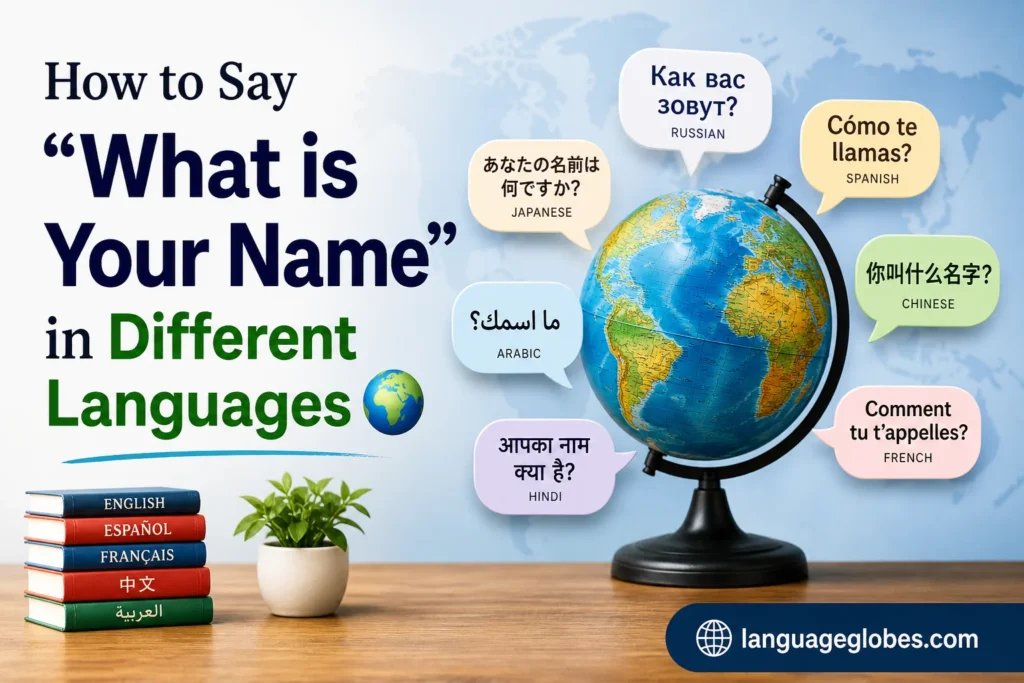
Many people search How to Say “What is Your Name” in Different Languages to start conversations and connect across cultures easily.
From my experience traveling and making new friends online, this basic and friendly phrase is one of the best ways to connect with others. If you are studying languages or just curious, this simple step helps you open doors and build relationships. A good guide will help you learn to say What is your name by using different translations, clear English pronunciation, meanings, and example sentences.
In many ways, this is among the most fundamental questions we ask when meeting someone. It acts as a universal gesture to initiate a conversation and establish a connection. I have noticed how it can vary significantly across cultures, turning it into a linguistic journey where you discover new styles of speaking. Knowing this is one of the first steps in building a real bond, since names carry identity, heritage, and personal history, and showing interest is a clear sign of respect and friendliness.
As you continue learning, you begin to break barriers and foster deeper relationships, whether for travel or business interactions that feel smoother. The true beauty of language lies in grammar, vocabulary, and rich cultural nuances. While asking someone’s name might seem straightforward, the way it is phrased with politeness embedded often varies between countries. This guide provides translations of What is your name in over 70 languages across European, Asian, African, and Middle Eastern regions, with complete pronunciations and example sentences. These expressions help you embrace diversity, enhance communication, and create meaningful connections worldwide.
Interesting Facts About “How to Say What is Your Name”
- Asking someone’s name is universally considered a polite introduction.
- Different cultures have formal and informal ways to ask names.
- Learning names in the local language shows cultural sensitivity.
- Some languages include titles or honorifics when asking someone’s name.
- Children often learn this phrase first when studying a new language.
European Languages
European languages are diverse, with roots in Latin, Germanic, Slavic, and other language families. Many of these languages have formal and informal ways of asking someone’s name. Below is a table with translations of “What is your name?” across popular European languages.
| Language | Country/Region | Translation | Pronunciation | Example Sentence |
| English (American) 🇺🇸 | USA | What is your name? | /wʌt ɪz jɔr neɪm/ | What is your name? My name is John. |
| English (British) 🇬🇧 | UK | What is your name? | /wɒt ɪz jɔːr neɪm/ | What is your name? I am Sarah. |
| English (Australian) 🇦🇺 | Australia | What is your name? | /wɒt ɪz jɔː neɪm/ | What is your name? They call me Liam. |
| Spanish 🇪🇸 | Spain | ¿Cómo te llamas? | /ˈko.mo te ˈʝa.mas/ | ¿Cómo te llamas? Me llamo Carlos. |
| French 🇫🇷 | France | Comment vous appelez-vous? | /kɔ.mɑ̃ vu za.pə.le vu/ | Comment vous appelez-vous? Je m’appelle Marie. |
| German 🇩🇪 | Germany | Wie heißen Sie? | /viː ˈhaɪ.sən ziː/ | Wie heißen Sie? Ich heiße Hans. |
| Italian 🇮🇹 | Italy | Come ti chiami? | /ˈko.me ti ˈkja.mi/ | Come ti chiami? Mi chiamo Lucia. |
| Portuguese 🇵🇹 | Portugal | Qual é o seu nome? | /kwaw ɛ u sew ˈnomi/ | Qual é o seu nome? Meu nome é João. |
| Russian 🇷🇺 | Russia | Как вас зовут? | /kak vas zəˈvut/ | Как вас зовут? Меня зовут Ivan. |
| Dutch 🇳🇱 | Netherlands | Hoe heet u? | /huː heːt y/ | Hoe heet u? Ik heet Anna. |
| Greek 🇬🇷 | Greece | Πώς σας λένε; | /pos sas ˈlene/ | Πώς σας λένε; Με λένε Nikos. |
| Swedish 🇸🇪 | Sweden | Vad heter du? | /vad ˈheːtɛr dʉː/ | Vad heter du? Jag heter Erik. |
| Polish 🇵🇱 | Poland | Jak masz na imię? | /jak maʂ na ˈimʲɛ/ | Jak masz na imię? Mam na imię Katarzyna. |
| Norwegian 🇳🇴 | Norway | Hva heter du? | /va ˈheːtər dʉː/ | Hva heter du? Jeg heter Ole. |
| Danish 🇩🇰 | Denmark | Hvad hedder du? | /vɛː ˈheðɐ dʊ/ | Hvad hedder du? Jeg hedder Mette. |
Asian Languages
Asia is home to thousands of languages with rich histories. The formality of addressing someone can vary greatly depending on the country, age, and social status. Here are common ways to ask “What is your name?” in major Asian languages.
| Language | Country/Region | Translation | Pronunciation | Example Sentence |
| Chinese (Mandarin) 🇨🇳 | China | 你叫什么名字? | /nǐ jiào shénme míngzì/ | 你叫什么名字?我叫 Li Wei. |
| Japanese 🇯🇵 | Japan | お名前は何ですか? | /o-na-mae wa nan desu ka/ | お名前は何ですか?私は Yuki です。 |
| Korean 🇰🇷 | South Korea | 이름이 뭐예요? | /i-reum-i mwo-ye-yo/ | 이름이 뭐예요? 제 이름은 Minho입니다. |
| Hindi 🇮🇳 | India | आपका नाम क्या है? | /aapka naam kya hai/ | आपका नाम क्या है? मेरा नाम Arjun है। |
| Bengali 🇧🇩 | Bangladesh | তোমার নাম কি? | /tomar nam ki/ | তোমার নাম কি? আমার নাম Ayesha. |
| Thai 🇹🇭 | Thailand | คุณชื่ออะไร? | /khun chue arai/ | คุณชื่ออะไร? ฉันชื่อ Somchai. |
| Vietnamese 🇻🇳 | Vietnam | Bạn tên là gì? | /ban ten la zi/ | Bạn tên là gì? Tôi tên là Linh. |
| Urdu 🇵🇰 | Pakistan | آپ کا نام کیا ہے؟ | /aap ka naam kya hai/ | آپ کا نام کیا ہے؟ میرا نام Ahmed ہے۔ |
| Malay 🇲🇾 | Malaysia | Siapa nama anda? | /siapa ˈnama anda/ | Siapa nama anda? Nama saya Farid. |
| Indonesian 🇮🇩 | Indonesia | Siapa namamu? | /siapa na.ma.mu/ | Siapa namamu? Namaku Budi. |
| Filipino 🇵🇭 | Philippines | Ano ang pangalan mo? | /ˈano aŋ paŋˈɡalan mo/ | Ano ang pangalan mo? Ang pangalan ko ay Maria. |
| Tamil 🇮🇳 | India/Sri Lanka | உங்கள் பெயர் என்ன? | /uṅkaḷ peyar eṉṉa/ | உங்கள் பெயர் என்ன? என் பெயர் Ravi. |
| Telugu 🇮🇳 | India | మీ పేరు ఏమిటి? | /mī pēru ēmiṭi/ | మీ పేరు ఏమిటి? నా పేరు Priya. |
| Kannada 🇮🇳 | India | ನಿಮ್ಮ ಹೆಸರು ಏನು? | /nimma hesaru ēnu/ | ನಿಮ್ಮ ಹೆಸರು ಏನು? ನನ್ನ ಹೆಸರು Rakesh. |
African Languages
African languages are incredibly diverse, with several belonging to major language families like Niger-Congo, Afroasiatic, and Khoisan. Greetings and introductions often carry cultural weight.
| Language | Country/Region | Translation | Pronunciation | Example Sentence |
| Swahili 🇰🇪 | Kenya/Tanzania | Jina lako nani? | /ˈdʒi.na ˈla.ko ˈna.ni/ | Jina lako nani? Jina langu ni Amina. |
| Zulu 🇿🇦 | South Africa | Ubani igama lakho? | /uˈbani ˈiɡama ˈlaxɔ/ | Ubani igama lakho? Igama lami ngingu Sipho. |
| Hausa 🇳🇪 | Nigeria/Niger | Mene ne sunanka? | /ˈmene ne suˈnanka/ | Mene ne sunanka? Sunana Musa. |
| Amharic 🇪🇹 | Ethiopia | ስምህ ማን ነው? | /sɨmɨh man naw/ | ስምህ ማን ነው? ስሜ አሰፋ ነው. |
| Yoruba 🇳🇬 | Nigeria | Kini orukọ rẹ? | /ˈkini ɔˈru.ko rɛ/ | Kini orukọ rẹ? Orukọ mi ni Tunde. |
| Somali 🇸🇴 | Somalia | Magacaa? | /ma.ga.caː/ | Magacaa? Magacaygu waa Ayaan. |
| Igbo 🇳🇬 | Nigeria | Kedu aha gị? | /ˈke.du ˈa.ha ɡi/ | Kedu aha gị? Aha m bụ Chinedu. |
| Shona 🇿🇼 | Zimbabwe | Zita rako ndiani? | /ˈzi.ta ra.ko nˈdi.a.ni/ | Zita rako ndiani? Zita rangu ndi Tawanda. |
| Malagasy 🇲🇬 | Madagascar | Iza no anaranao? | /ˈiza nu anaˈra.na.u/ | Iza no anaranao? Ny anarako dia Hery. |
Read More: How to Say “Happy Valentine’s Day” in Different Languages
Middle Eastern Languages
Middle Eastern languages often reflect centuries of history and culture. Many of these languages use formalities and honorifics when asking someone’s name.
| Language | Country/Region | Translation | Pronunciation | Example Sentence |
| Arabic 🇸🇦 | Saudi Arabia | ما اسمك؟ | /ma ismuk/ | ما اسمك؟ اسمي Ahmad. |
| Persian 🇮🇷 | Iran | نام شما چیست؟ | /nâm-e shomâ chist/ | نام شما چیست؟ نام من نادر است. |
| Hebrew 🇮🇱 | Israel | מה שמך? | /ma shimcha/ | מה שמך? שמי David. |
| Turkish 🇹🇷 | Turkey | Adınız ne? | /adɯnɯz ne/ | Adınız ne? Adım Mehmet. |
| Kurdish 🇮🇶/🇹🇷 | Iraq/Turkey | Navê te çi ye? | /navɛ te tʃi jɛ/ | Navê te çi ye? Navê min Sara ye. |
| Pashto 🇦🇫 | Afghanistan | ستا نوم څه دی؟ | /sta num tsə de/ | ستا نوم څه دی؟ زما نوم Ahmad دی. |
| Kurdish (Sorani) 🇮🇶 | Iraq | ناوت چیە؟ | /nawət tʃi.e/ | ناوت چیە؟ ناوی من Dilshadە. |
| Urdu 🇵🇰 | Pakistan | آپ کا نام کیا ہے؟ | /aap ka naam kya hai/ | آپ کا نام کیا ہے؟ میرا نام Ahmed ہے۔ |
FAQs
1. Why is it important to know how to ask someone’s name in different languages?
Knowing how to ask someone’s name shows respect, builds rapport, and facilitates smoother communication across cultures.
2. Are there formal and informal ways to ask someone’s name in other languages?
Yes, many languages have formal and informal versions depending on age, social status, or setting. For example, French has “Comment vous appelez-vous?” (formal) vs. “Comment tu t’appelles?” (informal).
3. Can learning someone’s name in their language improve cultural understanding?
Absolutely. It demonstrates interest in their culture, which can lead to more meaningful personal and professional connections.
4. Are there languages where asking a name is considered rude?
Some cultures have specific social protocols. While rare, it’s best to pair the question with polite greetings or use formal versions to avoid offense.
5. How can I practice these phrases effectively?
Use language learning apps, practice with native speakers, or repeat aloud with correct pronunciation to improve fluency and confidence.
Conclusion
Learning how to ask “What is your name?” in different languages is more than a practical skill—it’s a gateway to understanding culture, showing respect, and building human connections. From Europe to Asia, Africa to the Middle East, each language provides a unique way to engage with others. By embracing these expressions, you not only expand your linguistic abilities but also cultivate empathy and global awareness, making every interaction richer and more meaningful.

James Anderson is a passionate language enthusiast and content creator at LanguageGlobes. With a keen interest in global cultures and communication, he shares insightful and engaging content to help readers explore and master new languages.