
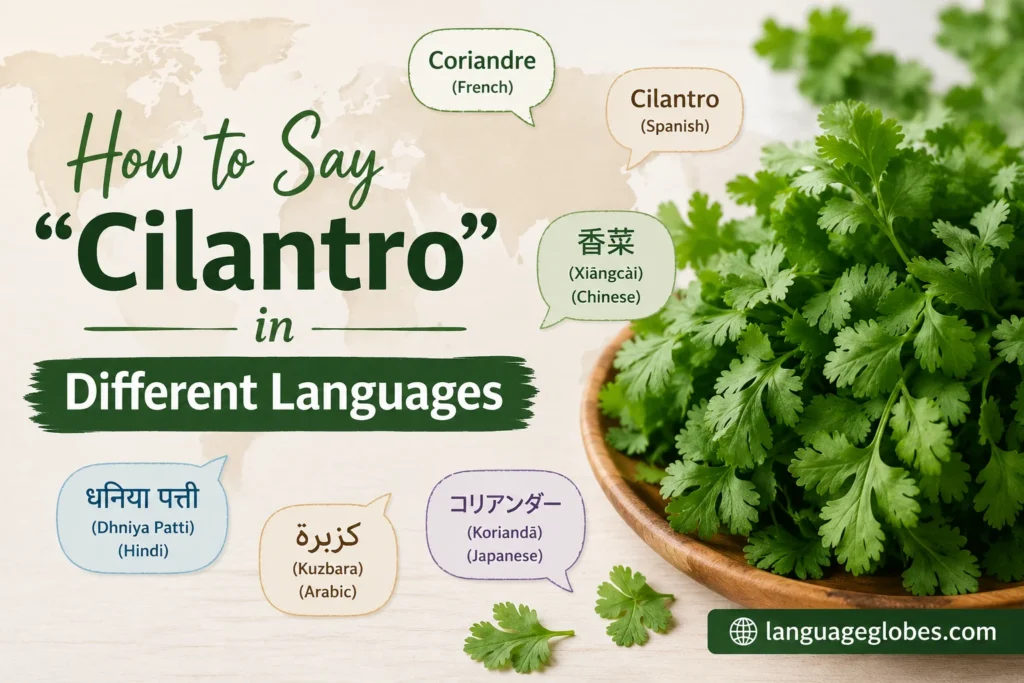
How to Say “Cilantro” in Different Languages shows how food, cultures, and simple words connect people worldwide through shared meals.
During my own linguistic journey through food markets and family kitchens, I saw how Language helps connect people from many cultures. A simple herb like Cilantro brings a fresh, citrusy flavor and vibrant flavor to cuisines worldwide, including Mexican salsas, Indian chutneys, and Middle Eastern salads. Its unique taste, versatility, and burst of freshness make it a beloved herb used in everyday dishes, salsas, and curries across the world. What feels most fascinating is the diverse array of names found in different languages, with each term shaped by local traditions, regions, and cultural identity.
This article helps readers discover how cilantro is expressed in 70 different languages around the globe. From the rolling hills of Italy to the bustling streets of Tokyo, language changes through history, trade, and daily communication. While traveling and cooking an international recipe, I noticed that learning simple food terms creates practical bridges between communities. It also improves understanding, supports learning vocabulary, and helps people translate words while exploring new languages and food traditions.
These meaningful phrases and everyday terms are more than simple vocabulary. They become powerful tools for building emotional connections, encouraging understanding global cultures, and helping people open doors to richer experiences. Whether someone is studying food traditions, sharing expressions of love through meals, or learning the cultural significance behind cilantro, each word becomes a meaningful step toward global communication. As we uncover the linguistic richness of this flavorful staple herb, we also celebrate shared memories and lasting human connection through food and language.
🌿 Interesting Facts About Cilantro
- Cilantro vs Coriander: In many parts of the world, cilantro refers to the leaves, while coriander refers to the seeds.
- Global Popularity: Used in cuisines from Latin America to South Asia.
- Love It or Hate It: Some people find cilantro tastes like soap due to genetic differences.
- Ancient Herb: It has been used for over 7,000 years in cooking and medicine.
- Multiple Names: One of the most linguistically diverse herbs in the world.
🌍 European Languages
European languages reflect centuries of shared history, trade, and cultural exchange. Many languages in this region derive from Latin, Greek, or Germanic roots, which is why you’ll notice similarities in words for cilantro. In Europe, the term often leans toward “coriander” rather than “cilantro.”
Cilantro in European Languages
| Language | Country/Region | Translation | Pronunciation | Example Sentence |
| American English 🇺🇸 | USA | Cilantro | si-LAN-tro | I added fresh cilantro to the salsa. |
| British English 🇬🇧 | UK | Coriander | kor-ee-AN-der | Add coriander to the curry. |
| Australian English 🇦🇺 | Australia | Coriander | kor-ee-AN-der | Fresh coriander tastes great. |
| Spanish 🇪🇸 | Spain | Cilantro | see-LAN-tro | El cilantro es muy fresco. |
| French 🇫🇷 | France | Coriandre | ko-ree-AHN-druh | J’aime la coriandre dans les plats. |
| German 🇩🇪 | Germany | Koriander | ko-ree-AN-der | Koriander ist ein Gewürz. |
| Italian 🇮🇹 | Italy | Coriandolo | ko-ree-AN-do-lo | Uso coriandolo fresco. |
| Portuguese 🇵🇹 | Portugal | Coentro | co-EN-tro | O coentro é delicioso. |
| Dutch 🇳🇱 | Netherlands | Koriander | ko-ree-AN-der | Ik gebruik koriander. |
| Swedish 🇸🇪 | Sweden | Koriander | ko-ree-AN-der | Koriander är gott. |
| Norwegian 🇳🇴 | Norway | Koriander | ko-ree-AN-der | Jeg liker koriander. |
| Danish 🇩🇰 | Denmark | Koriander | ko-ree-AN-der | Koriander bruges i mad. |
| Finnish 🇫🇮 | Finland | Korianteri | ko-ree-AN-ter-i | Korianteri on hyvä. |
| Polish 🇵🇱 | Poland | Kolendra | ko-LEN-dra | Kolendra jest aromatyczna. |
| Czech 🇨🇿 | Czech Republic | Koriandr | ko-ree-AN-der | Koriandr chutná dobře. |
| Hungarian 🇭🇺 | Hungary | Koriander | ko-ree-AN-der | Koriander finom. |
| Greek 🇬🇷 | Greece | Koriandros | ko-ree-AN-dros | Μου αρέσει ο κόλιανδρος. |
| Romanian 🇷🇴 | Romania | Coriandru | ko-ree-AN-dru | Coriandru este gustos. |
🌏 Asian Languages
Asia is home to immense linguistic diversity, with languages influenced by ancient traditions, religions, and culinary practices. Cilantro is widely used across Asian cuisines, especially in India, Thailand, Vietnam, and China, where it often plays a key role in flavoring dishes.
Cilantro in Asian Languages
| Language | Country/Region | Translation | Pronunciation | Example Sentence |
| Urdu 🇵🇰 | Pakistan | دھنیا | dhun-ya | میں نے دھنیا شامل کیا۔ |
| Hindi 🇮🇳 | India | धनिया | dha-ni-ya | मैंने धनिया डाला। |
| Bengali 🇧🇩 | Bangladesh | ধনিয়া | dho-ni-ya | ধনিয়া সুগন্ধি। |
| Punjabi 🇵🇰🇮🇳 | Punjab | دھنیا | dhun-ya | دھنیا مزے دار ہے۔ |
| Tamil 🇮🇳 | India | கொத்தமல்லி | ko-tha-mal-li | கொத்தமல்லி சுவையாக உள்ளது. |
| Telugu 🇮🇳 | India | కొత్తిమీర | ko-thi-mee-ra | కొత్తిమీర వాడాను. |
| Kannada 🇮🇳 | India | ಕೊತ್ತಂಬರಿ | ko-tham-ba-ri | ಕೊತ್ತಂಬರಿ ರುಚಿಕರವಾಗಿದೆ. |
| Malayalam 🇮🇳 | India | മല്ലിയില | mal-li-yi-la | മല്ലിയില ചേർത്തു. |
| Chinese (Mandarin) 🇨🇳 | China | 香菜 | xiang-cai | 我喜欢香菜。 |
| Japanese 🇯🇵 | Japan | パクチー | pa-ku-chee | パクチーが好きです。 |
| Korean 🇰🇷 | Korea | 고수 | go-su | 고수를 넣었어요. |
| Thai 🇹🇭 | Thailand | ผักชี | phak-chee | ผักชีอร่อยมาก |
| Vietnamese 🇻🇳 | Vietnam | Rau mùi | rau-mui | Rau mùi rất ngon. |
| Indonesian 🇮🇩 | Indonesia | Ketumbar | ke-tum-bar | Ketumbar digunakan. |
| Malay 🇲🇾 | Malaysia | Daun ketumbar | da-un ke-tum-bar | Saya suka daun ketumbar. |
| Filipino 🇵🇭 | Philippines | Wansoy | wan-soy | Masarap ang wansoy. |
🌍 African Languages
Africa’s languages are incredibly rich and diverse, shaped by indigenous cultures and colonial influences. Cilantro is used in many African cuisines, especially in North and East Africa. The word often resembles “coriander” due to historical trade connections.
Cilantro in African Languages
| Language | Country/Region | Translation | Pronunciation | Example Sentence |
| Swahili 🇰🇪 | East Africa | Giligilani | gi-li-gi-la-ni | Giligilani ni nzuri. |
| Amharic 🇪🇹 | Ethiopia | ኮሪአንደር | ko-ree-an-der | ኮሪአንደር ጣፋጭ ነው |
| Yoruba 🇳🇬 | Nigeria | Coriander | ko-ree-an-der | Mo fẹ coriander. |
| Zulu 🇿🇦 | South Africa | Coriander | ko-ree-an-der | Ngiyathanda coriander. |
| Afrikaans 🇿🇦 | South Africa | Koljander | kol-yan-der | Koljander is lekker. |
| Somali 🇸🇴 | Somalia | Kinsar | kin-sar | Kinsar waa fiican. |
| Hausa 🇳🇬 | Nigeria | Korianda | ko-ree-an-da | Korianda yana da dadi. |
| Igbo 🇳🇬 | Nigeria | Coriander | ko-ree-an-der | Coriander dị ụtọ. |
Read More: How to Say “The Clouds” in Different Languages
🌍 Middle Eastern Languages
Middle Eastern languages have deep historical roots and are closely tied to ancient civilizations. Cilantro is a staple herb in this region, used in dishes like salads, soups, and stews. The word often resembles “kuzbara” or variations of coriander.
Cilantro in Middle Eastern Languages
| Language | Country/Region | Translation | Pronunciation | Example Sentence |
| Arabic 🇸🇦 | Middle East | كزبرة | kuz-ba-ra | الكزبرة لذيذة |
| Persian 🇮🇷 | Iran | گشنیز | gosh-neez | گشنیز خوشمزه است |
| Turkish 🇹🇷 | Turkey | Kişniş | kish-nish | Kişniş kullanıyorum |
| Hebrew 🇮🇱 | Israel | כוסברה | kus-ba-ra | אני אוהב כוסברה |
| Kurdish | Kurdistan | Gijneez | gij-neez | Gijneez baş e |
| Pashto 🇦🇫 | Afghanistan | دھنیا | dhun-ya | دھنیا خوندور دی |
❓ FAQs
Even though this article focuses on cilantro, many readers are also interested in expressing emotions across languages. Here are some helpful FAQs:
1. Why is “I love you” important to learn in different languages?
It helps build emotional connections and shows respect for other cultures.
2. What is “I love you” in Spanish?
“Te amo” or “Te quiero.”
3. How do you say it in French?
“Je t’aime.”
4. What about in Urdu?
“میں تم سے محبت کرتا ہوں” (Main tum se mohabbat karta hoon).
5. Is it the same in every culture?
No, some cultures express love more indirectly.
6. What is the easiest language to learn love phrases in?
Spanish and French are often considered beginner-friendly.
7. How do you say it in Japanese?
“Aishiteru” (あいしてる).
8. Can body language replace words?
Sometimes, yes—especially in cultures where verbal expression is less common.
9. Is pronunciation important?
Yes, correct pronunciation shows effort and respect.
10. Are there formal vs informal versions?
Yes, many languages have different forms depending on context.
📝 Conclusion
Learning how to say simple words like cilantro in different languages might seem small, but it reflects a much larger journey—one of cultural appreciation, curiosity, and connection. Just as learning to say “I love you” can strengthen emotional bonds, learning everyday vocabulary can make travel, cooking, and communication more meaningful.
In a globalized world, even a single word can open doors to understanding traditions, cuisines, and histories. Whether you’re ordering food abroad, reading a recipe, or connecting with someone from another culture, these small linguistic efforts make a big difference.

Joshua Lewis is a passionate language enthusiast and content creator at LanguageGlobes.com. He specializes in exploring global languages, cultures, and communication trends, helping readers connect with the world through words.