
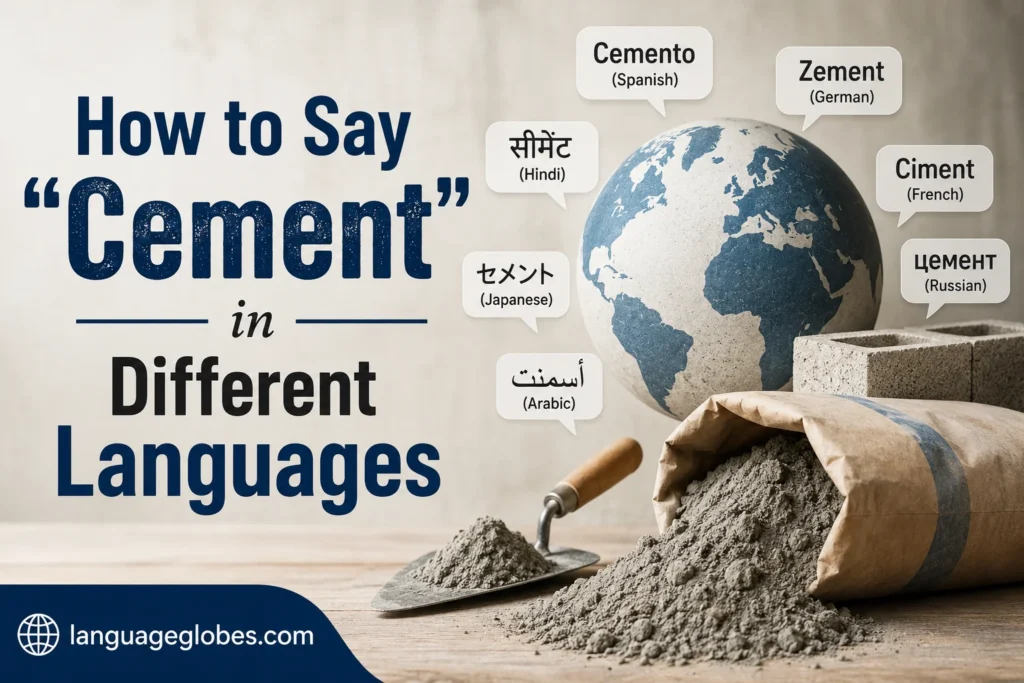
“How to Say “Cement” in Different Languages” helps curious travelers and engineers connect through shared vocabulary, cultural nuance and communication.
As a language lover, I always enjoy exploring how the phrase the cement is expressed across the world in 70+ languages. Every culture has unique grammatical structures, pronunciation patterns and tradition, which makes language learning more meaningful. From European, Asian, African and Middle Eastern languages to modern global projects, words become powerful tools that help humans learn, express simple concepts and build mutual understanding and respect in both casual conversations and professional environments.
Cultural Meaning and Practical Use of Cement in Different Languages
This article will explore how knowing how to say cement in many languages can create deeper cultural appreciation and improve practical communication. In daily life, construction workers and designers often use different terms based on local architectural styles and regional traditions. These phrases, example sentences, and complete pronunciation guides give readers useful insight into global terminology, shared project discussions, modern development and global teamwork, while helping societies share meaning through construction, architecture and cultural identity.
Interesting Facts About “Cement”
- 🧠 Linguistic diversity: There are over 7,000 languages spoken worldwide, and even simple words like “cement” can have unique translations and usage depending on the language family.
- 🌍 Cultural concepts: Some languages borrow the word cement directly from other languages like English, especially in technical or industrial contexts.
- 🗣️ Pronunciation patterns: The way “cement” is pronounced varies significantly, especially in tonal languages (e.g., Mandarin Chinese) or languages with unique phonemes (e.g., Arabic).
- 📘 Grammatical forms: Some languages, like German, use gender and articles differently, so “the cement” has a specific form rather than just a direct translation.
European Languages
Europe is home to many of the world’s major language families, including Romance, Germanic, and Slavic. Languages in this region often share historical roots but can differ widely in grammar and pronunciation. They’ve been shaped by centuries of literature, trade, and cultural exchange — making each translation both unique and fascinating.
| Language | Country/Region | Translation | Pronunciation | Example Sentence |
| 🇺🇸 American English | USA | the cement | /ðə səˈmɛnt/ | The workers poured the cement into the foundation. |
| 🇬🇧 British English | UK | the cement | /ðə ˈsɛm(ə)nt/ | The mason spread the cement evenly. |
| 🇦🇺 Australian English | Australia | the cement | /ðə səˈmɛnt/ | We mixed the cement before it got hot. |
| 🇪🇸 Spanish | Spain | el cemento | /el θeˈmento/ | El albañil echó el cemento en el muro. |
| 🇫🇷 French | France | le ciment | /lə si.mɑ̃/ | Le maçon a appliqué le ciment sur les briques. |
| 🇩🇪 German | Germany | der Zement | /deːɐ̯ tseˈmeːnt/ | Der Bauarbeiter mischte den Zement. |
| 🇮🇹 Italian | Italy | il cemento | /il tʃeˈmento/ | Hanno versato il cemento nella trincea. |
| 🇵🇹 Portuguese | Portugal | o cimento | /u siˈmẽtu/ | Eles colocaram o cimento lentamente. |
| 🇷🇺 Russian | Russia | цемент (tsement) | /tsɪˈmʲent/ | Рабочие заливают цемент в форму. |
| 🇳🇱 Dutch | Netherlands | het cement | /hɛt seˈmɛnt/ | De bouwers gebruikten het cement. |
| 🇸🇪 Swedish | Sweden | cementen | /seˈmɛnːtɛn/ | Cementen ligger klar på plats. |
| 🇵🇱 Polish | Poland | cement | /ˈtsɛmɛnt/ | Robotnicy wylali cement. |
| 🇬🇷 Greek | Greece | το τσιμέντο (to tsimento) | /to tsiˈmɛndo/ | Έριξαν το τσιμέντο στο πάτωμα. |
| 🇭🇺 Hungarian | Hungary | a cement | /ɒ ˈtsɛmɛnt/ | A munkások öntötték a cementet. |
| 🇨🇿 Czech | Czech Republic | cement | /ˈtsɛmɛnt/ | Někdo nalil cement do bednění. |
Asian Languages
Asia contains the greatest linguistic diversity of any continent, with languages rooted in families like Sino‑Tibetan, Indo‑Aryan, Dravidian, Altaic, Austronesian, and many more. Here, we see a mix of phonetic, syllabic, and even logographic writing systems — each shaping the translation of everyday words differently.
| Language | Country/Region | Translation | Pronunciation | Example Sentence |
| 🇨🇳 Mandarin Chinese | China | 水泥 (shuǐní) | /ʂwèi.nǐ/ | 工人正在倒水泥。 |
| 🇯🇵 Japanese | Japan | セメント (semento) | /seːmen̩to/ | 彼らはセメントを混ぜます。 |
| 🇰🇷 Korean | South Korea | 시멘트 (simenteu) | /ɕi.mɛn.tʰɯ/ | 우리는 시멘트를 부었습니다. |
| 🇮🇳 Hindi | India | सीमेंट (seement) | /siːˈmeːnt/ | मज़दूर सीमेंट डाल रहे हैं। |
| 🇧🇩 Bengali | Bangladesh | সিমেন্ট (simenṭ) | /ʃiˈment/ | তারা সিমেন্ট মিশিয়েছে। |
| 🇻🇳 Vietnamese | Vietnam | xi măng | /si˨˩ maŋ˦/ | Người thợ đổ xi măng. |
| 🇮🇩 Indonesian | Indonesia | semen | /ˈsəmɛn/ | Mereka menuang semen di sini. |
| 🇹🇭 Thai | Thailand | ปูนซีเมนต์ (poon see‑men) | /puːn siːmen/ | คนงานเท ปูนซีเมนต์. |
| 🇵🇭 Filipino / Tagalog | Philippines | semento | /seˈmɛnto/ | Ang mga trabahador ay naglalagay ng semento. |
| 🇲🇾 Malay | Malaysia | simen | /ˈsimɛn/ | Mereka mencampur simen. |
| 🇰🇬 Kazakh | Kazakhstan | цемент (tsement) | /t͡sɪmʲent/ | Жұмысшылар цемент құйды. |
| 🇵🇰 Urdu | Pakistan | سیمنٹ (sement) | /siːˈmɛnt/ | مزدور سیمنٹ ڈال رہے ہیں۔ |
| 🇳🇵 Nepali | Nepal | सिमेन्ट (simenṭ) | /siˈmenʈ/ | उनीहरूले सिमेन्ट हालिरहेका छन्। |
| 🇱🇦 Lao | Laos | ຊີເມນທ໌ (see‑men) | /siː.men/ | ພະນັກງານແຕ່ງ ຊີເມນທ໌ |
African Languages
Africa is extremely diverse linguistically, with several major families like Afro‑Asiatic, Niger‑Congo, Nilo‑Saharan, and Khoisan languages. Many African languages have adopted loan words like cement via European influence, especially through trade, education, and industry.
| Language | Country/Region | Translation | Pronunciation | Example Sentence |
| 🇿🇦 Zulu | South Africa | isimende | /iˈsiːmɛndɛ/ | Abasebenzi bafaka isimende. |
| 🇪🇹 Amharic | Ethiopia | ሲሜንት (siment) | /siːˈment/ | ሰራተኞች ሲሜንት ይዘጋጁ። |
| 🇰🇪 Swahili | Kenya | saruji | /saˈru.d͡ʒi/ | Wafanyakazi wanaweka saruji. |
| 🇳🇬 Yoruba | Nigeria | simenti | /siˈmɛnti/ | Ọmọ iṣẹ sementi n dun. |
| 🇲🇦 Berber (Tamazight) | Morocco | asemment | /aˈsɛmmɛnt/ | Imɣaraben yeddan asemment. |
| 🇬🇭 Twi | Ghana | simeɛnti | /siˈmɛn.ti/ | Adwumayɛfoɔ de simeɛnti guare. |
| 🇸🇩 Arabic (Sudanese dialect) | Sudan | الأسمنت (al‑asment) | /æl.æsˈment/ | العمال صبّوا الأسمنت. |
| 🇰🇲 Comorian | Comoros | simenti | /siˈmɛnti/ | Wafanyakazi wanaweka simenti. |
| 🇹🇿 Chaga | Tanzania | simenti | /siˈmɛnti/ | Walimu wa kazi waliweka simɛnti. |
Read More: How to Say “Cell Phone” in Different Languages
Middle Eastern Languages
The Middle East is a crossroads of cultural and linguistic exchange. Languages here often reflect centuries of literature, religion, and trade. While some languages like Arabic have complex script systems, others like Turkish adapt borrowed words to their own phonetic structures.
| Language | Country/Region | Translation | Pronunciation | Example Sentence |
| 🇸🇦 Arabic (Modern Standard) | Saudi Arabia | الأسمنت (al‑asment) | /æl.æsˈment/ | العمال يسكبون الأسمنت. |
| 🇹🇷 Turkish | Turkey | çimento | /t͡ʃimen.to/ | İşçiler çimento döktü. |
| 🇮🇱 Hebrew | Israel | מלט (me’let) | /meˈlet/ | העובדים שופכים מלט. |
| 🇮🇶 Kurdish | Iraq | çiment | /t͡ʃiˈmɛnt/ | Karûbar wan çiment dan. |
| 🇸🇾 Arabic (Syrian dialect) | Syria | السِّمنت (es‑siment) | /es.sɪˈment/ | الشُغّالين عم يصبّوا السِّمنت. |
| 🇱🇧 Arabic (Lebanese dialect) | Lebanon | السِّمنت (es‑siment) | /es.sɪˈment/ | عمال عم يخلّطوا السِّمنت. |
| 🇴🇲 Arabic (Omani dialect) | Oman | السِّم⁽ن⁾ت (es‑simint) | /es.siˈmɪnt/ | الحرفيين عم يسكّبوا السِّم⁽ن⁾ت. |
| 🇾🇪 Arabic (Yemeni dialect) | Yemen | السيمنت (as‑syment) | /æs.siˈment/ | العمال بيصبّوا السيمنت. |
FAQs
1. Is “cement” pronounced the same in all languages?
Not always — while many languages borrow the word cement directly from English or French, the pronunciation differs with local phonemes and accents.
2. Why do some languages use borrowed words like “semento” or “cemento”?
Many languages adopt technical or industrial terms from other languages due to historical trade, colonization, or technology exchange.
3. Are articles included when translating “the cement”?
Yes — in languages with definite articles (like Spanish el or French le), the article becomes part of the translation.
4. How can I practice these phrases correctly?
Use language apps, pronunciation tools, or practice with native speakers to master both the pronunciation and context.
5. Why does Swahili use “saruji” instead of a direct loan from English?
Some languages develop their own technical vocabulary rooted in local linguistic traditions.
6. Can I use these translations in construction conversations?
Yes — learning how to say cement in another language is practical in construction, trade, and travel contexts.
7. Are dialect differences important?
Absolutely — regional dialects can change pronunciation, articles, or even the root word itself.
8. Are there languages where “cement” isn’t used at all?
Some small or indigenous languages may not have a native term and might instead use borrowed words or descriptive phrases.
9. Why are there different translations within the same language group (like Arabic)?
Dialects vary across regions, so spoken Arabic in Lebanon sounds different from Sudanese or Yemeni Arabic.
10. How can knowing these phrases improve cultural understanding?
It shows respect for local languages and can enhance connection, trust, and communication in multicultural environments.
Conclusion
Learning how to say everyday terms like “the cement” across multiple languages may seem simple on the surface — yet it opens a window into the rich linguistic and cultural diversity of our world. From the Romance roots of French and Spanish to the tonal systems of Mandarin and the intricate scripts of Arabic, each language brings its own flavor of expression.
By exploring these translations — complete with pronunciation and examples — you don’t just learn vocabulary; you step into a broader understanding of how people around the globe make meaning out of the same object. Whether you’re renovating a home in Berlin, talking with craftsmen in Tokyo, or ordering supplies in Nairobi, knowing local terms builds bridges and enriches your global perspective.
So keep exploring, keep listening, and enjoy the beauty of language — one word at a time.

Joshua Lewis is a passionate language enthusiast and content creator at LanguageGlobes.com. He specializes in exploring global languages, cultures, and communication trends, helping readers connect with the world through words.