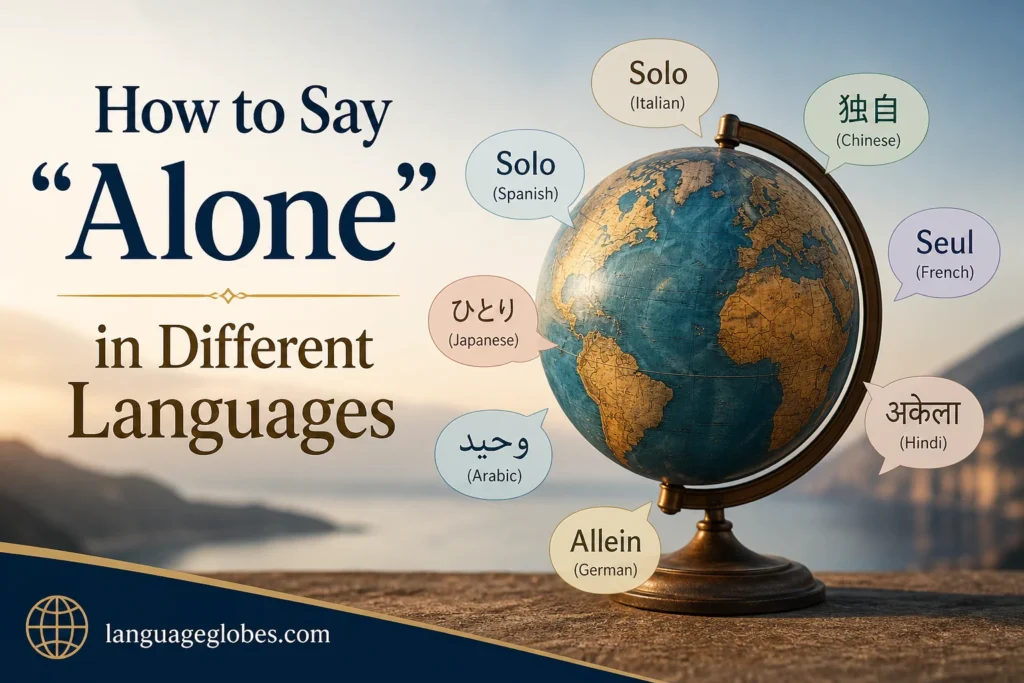
How to Say “Alone” in Different Languages reveals how alone as a word and feeling reflects a universal human experience across cultures.
The idea of alone goes beyond a simple term; it carries a deep emotion shaped by cultures, contexts, and personal experiences. While traveling and connecting with friends around the world, I noticed how this concept is expressed uniquely in different languages worldwide. It blends solitude, reflection, loneliness, and isolation, forming a complex state that can feel peaceful, lonely, or even quietly strong, depending on the meaning we attach to it.
When people search to understand how to say this in 70 different forms, they often look beyond basic translations. They want to express independence, being oneself, and real-life emotions. A good guide shows pronunciations, meanings, and examples, while also highlighting linguistic diversity that shapes understanding. This concept helps communicate states more effectively, whether through writing, learning new words, or forming connections. It opens doors to cultural insights, broadens perspective, and adds richness to human experience.
Interesting Facts About “Alone”
- The concept of being “alone” varies across cultures: in some societies, solitude is cherished, while in others, it may carry a negative connotation.
- In literature, “alone” often symbolizes self-discovery or isolation, a theme common in stories worldwide.
- Translating “alone” can sometimes require context, as languages distinguish between physical alone, emotional alone, and social isolation.
- Emojis like 😔 or 🧘♂️ are often used digitally to express the feeling of being alone.
European Languages
Europe is home to a rich diversity of languages, each with unique expressions of solitude. Here’s how to say “alone” in some of the major European languages:
| Language | Country/Region | Translation | Pronunciation | Example Sentence |
| English (American) 🇺🇸 | USA | Alone | ə-LOHN | I like spending time alone on Sundays. |
| English (British) 🇬🇧 | UK | Alone | ə-LOHN | She was alone in the garden. |
| English (Australian) 🇦🇺 | Australia | Alone | ə-LOHN | He prefers to be alone when reading. |
| French 🇫🇷 | France | Seul | səl | Je suis seul ce soir. (I am alone tonight.) |
| Spanish 🇪🇸 | Spain | Solo | SO-lo | Ella está sola en casa. (She is alone at home.) |
| Italian 🇮🇹 | Italy | Solo | SO-lo | Voglio stare solo un po’. (I want to be alone for a bit.) |
| German 🇩🇪 | Germany | Allein | a-LEIN | Ich bin heute Abend allein. (I am alone tonight.) |
| Portuguese 🇵🇹 | Portugal | Sozinho | so-ZEE-nyo | Ele está sozinho em casa. (He is alone at home.) |
| Dutch 🇳🇱 | Netherlands | Alleen | AH-leen | Ze is alleen thuis. (She is alone at home.) |
| Swedish 🇸🇪 | Sweden | Ensam | EN-sam | Jag är ensam idag. (I am alone today.) |
| Russian 🇷🇺 | Russia | Один | A-deen | Он сегодня один. (He is alone today.) |
| Polish 🇵🇱 | Poland | Sam | sam | Ona jest dziś sama. (She is alone today.) |
| Greek 🇬🇷 | Greece | Μόνος | MO-nos | Είμαι μόνος στο σπίτι. (I am alone at home.) |
| Norwegian 🇳🇴 | Norway | Alene | a-LE-ne | Jeg er alene hjemme. (I am alone at home.) |
European languages often have gendered forms of “alone,” e.g., French “seul” (masculine) / “seule” (feminine).
Asian Languages
Asia’s linguistic diversity reflects centuries of rich culture, philosophy, and art. Many Asian languages have unique ways to convey the concept of being alone:
| Language | Country/Region | Translation | Pronunciation | Example Sentence |
| Mandarin 🇨🇳 | China | 独自 | dú zì | 我喜欢独自散步。 (I like walking alone.) |
| Cantonese 🇭🇰 | Hong Kong | 一個人 | yat go yan | 我今晚一個人。 (I am alone tonight.) |
| Japanese 🇯🇵 | Japan | 一人 | hitori | 私は一人で映画を見ます。 (I watch movies alone.) |
| Korean 🇰🇷 | South Korea | 혼자 | hon-ja | 나는 혼자 집에 있어요. (I am alone at home.) |
| Hindi 🇮🇳 | India | अकेला | a-ke-la | मैं अकेला हूँ। (I am alone.) |
| Bengali 🇧🇩 | Bangladesh | একা | e-ka | আমি একা আছি। (I am alone.) |
| Thai 🇹🇭 | Thailand | คนเดียว | kon diao | ฉันอยู่คนเดียววันนี้ (I am alone today.) |
| Vietnamese 🇻🇳 | Vietnam | Một mình | mot minh | Tôi thích ở một mình. (I like being alone.) |
| Indonesian 🇮🇩 | Indonesia | Sendiri | sehn-DEH-ree | Saya ingin sendiri sebentar. (I want to be alone for a while.) |
| Malay 🇲🇾 | Malaysia | Sendirian | sen-DEE-ree-an | Dia sedang sendirian di rumah. (He is alone at home.) |
| Urdu 🇵🇰 | Pakistan | اکیلا | a-ke-la | میں اکیلا ہوں۔ (I am alone.) |
Asian languages often distinguish between physical solitude and emotional loneliness, with context shaping the translation.
African Languages
Africa’s linguistic landscape is incredibly diverse, with thousands of languages. Here are some common translations of “alone”:
| Language | Country/Region | Translation | Pronunciation | Example Sentence |
| Swahili 🇰🇪 | Kenya | Peke yake | PEH-keh YAH-keh | Niko peke yake nyumbani. (I am alone at home.) |
| Zulu 🇿🇦 | South Africa | Yedwa | YEH-dwah | Ngikhona yedwa. (I am alone.) |
| Xhosa 🇿🇦 | South Africa | Yedwa | YE-dwah | Ndikunye yedwa ekhaya. (I am alone at home.) |
| Amharic 🇪🇹 | Ethiopia | ብቻ | be-cha | እኔ ብቻ ነኝ። (I am alone.) |
| Hausa 🇳🇬 | Nigeria | Kaɗai | kah-DYE | Ina nan kaɗai. (I am alone here.) |
| Yoruba 🇳🇬 | Nigeria | Nikan | NEE-kan | Mo wa nikan ni ile. (I am alone at home.) |
| Somali 🇸🇴 | Somalia | Kaligay | KAH-lee-guy | Waxaan joogaa kaligay. (I am alone.) |
| Malagasy 🇲🇬 | Madagascar | Irery | EE-reh-ree | Irery aho an-trano. (I am alone at home.) |
African languages often use different words depending on gender, number, or social context.
Read More: How to Say “What Time Is It” in Different Languages
Middle Eastern Languages
The Middle East has a rich cultural history and languages with deep literary and poetic traditions:
| Language | Country/Region | Translation | Pronunciation | Example Sentence |
| Arabic 🇸🇦 | Saudi Arabia | وحيد | waheed | أنا وحيد في المنزل. (I am alone at home.) |
| Hebrew 🇮🇱 | Israel | לבד | le-vad | אני לבד בבית. (I am alone at home.) |
| Persian 🇮🇷 | Iran | تنها | tanhā | من تنها هستم. (I am alone.) |
| Turkish 🇹🇷 | Turkey | Yalnız | yal-niz | Evde yalnızım. (I am alone at home.) |
| Kurdish 🇹🇷/🇮🇶 | Iraq/Turkey | Tenê | TE-neh | Ez tenê me. (I am alone.) |
Middle Eastern languages often use poetic expressions for solitude, linking the word “alone” with reflection or spiritual states.
FAQ About Saying “Alone” in Different Languages
1. What does the word “alone” mean in different languages?
It usually means being by yourself, but the feeling can change—some languages show peace, while others show loneliness.
2. Is “alone” always a negative word?
No, in many cultures it can mean calmness, independence, or personal space, not just sadness.
3. Why does “alone” have different meanings across languages?
Because cultures view emotions differently, so the word reflects local beliefs, values, and social norms.
4. How can I learn to say “alone” in many languages?
You can use language apps, dictionaries, or guides that include translations and pronunciations.
5. Are there multiple words for “alone” in one language?
Yes, some languages have different words depending on whether it’s peaceful solitude or emotional loneliness.
6. How important is pronunciation when saying “alone” in other languages?
Very important, because wrong pronunciation can change the meaning or make it hard to understand.
7. Can learning this word improve my communication skills?
Yes, it helps you express emotions better and connect more deeply with people from other cultures.
8. Is “alone” used the same way in formal and informal contexts?
Not always; some languages use different forms depending on the situation or tone.
9. Why do travelers learn words like “alone” in other languages?
It helps them express personal feelings, ask for space, or understand others more clearly.
10. Does learning emotional words like “alone” help in language fluency?
Yes, emotional vocabulary adds depth to your language skills and makes conversations more natural.
Conclusion
Learning how to say “alone” in multiple languages not only expands your vocabulary but also provides insight into how different cultures view solitude. It allows you to communicate more effectively, whether traveling, writing, or connecting with friends globally. Words carry the nuances of culture, and understanding them helps us appreciate the universal yet diverse human experience of being alone.
I can also create a full downloadable table with all 70+ languages in one sheet for easy reference if you want

Joshua Lewis is a passionate language enthusiast and content creator at LanguageGlobes.com. He specializes in exploring global languages, cultures, and communication trends, helping readers connect with the world through words.