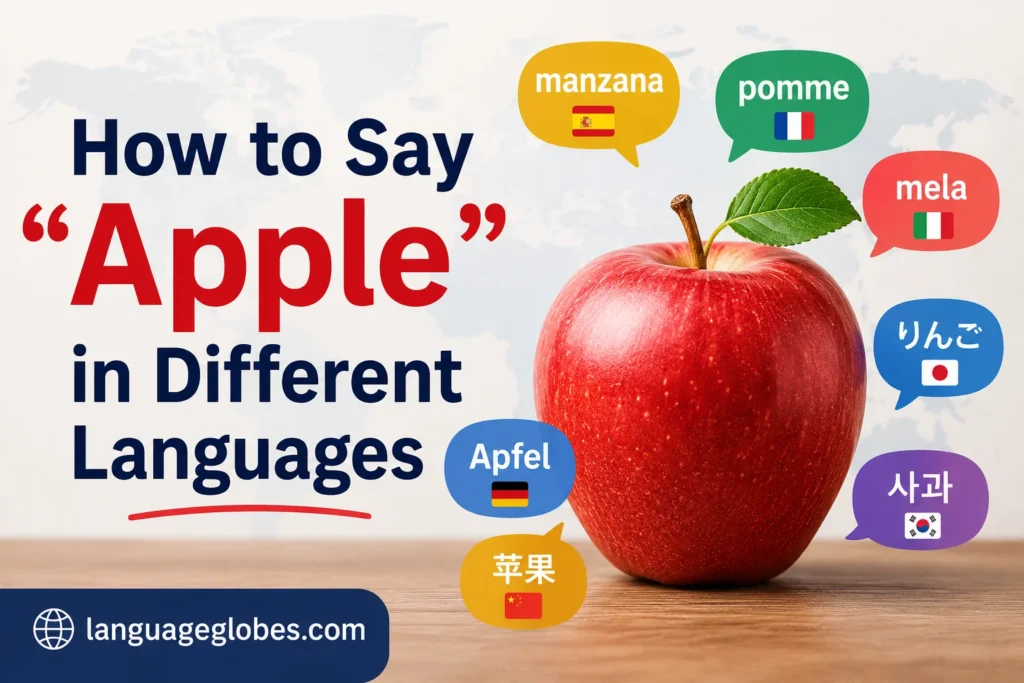
In this article on How to Say “Apple“ in Different Languages, I explore a simple yet power-filled idea of the word apple.
This beloved fruit and other fruits are known for their sweet taste and crisp texture, enjoyed across the globe, making them truly global and worldwide. Their significant cultural and historical importance in many societies makes them more than just food. The apple is a symbol of knowledge, temptation, peace, and health, especially in Western traditions, where it is used in ancient myths. In modern diets, it continues to symbolize beauty and nutrition, showing how one word can hold deep meaning in everyday life.
When people search for apple in different languages, they want to learn how this recognized term is expressed globally. In my own exploration, I have seen how translations, meanings, and pronunciations change based on language, script, and usage. These terms and words go beyond memorizing vocabulary—they are about building bridges and understanding between cultures. As a traveler, language lover, and student, I have found this process helps in celebrating and appreciating the beautiful ways we describe a part of life that feels truly universal.
This basic concept may seem small, but language truly carries history, culture, and identity. When you delve into 70+ languages across different regions, you begin exploring deeper connections. Each pronunciation, example sentence, and example helps reveal a rich heritage. As a global citizen, wanting to deepen your connection with others, or simply looking to enrich your worldview, this organized and clearly presented journey makes learning easy and enjoyably complete. It becomes a special place where diversity surrounds you, helping you say and represent the same idea in many linguistic forms, while still staying connected to one universal meaning.
⭐ Interesting Facts About How to Say Apple
Before we dive into the many ways to say apple, here are some fun tidbits:
- The English word apple comes from Old English æppel, which was a generic term for fruit in Germanic languages.
- Different languages sometimes use the word apple figuratively — for instance, in Russian, “яблоко от яблони недалеко падает” means “The apple doesn’t fall far from the tree.”
- Apples are a staple fruit in many cultures — so the word appears early in elementary language learning everywhere.
- In Japanese, apples are often associated with autumn and gift‑giving.
- In Irish Gaelic, the word for apple has connections to mythological apples of paradise.
🗺️ European Languages
Europe’s languages come from several major families — including Germanic, Romance, Slavic, and Celtic. These languages reflect centuries of history, literature, and regional identity.
| Language | Country/Region | Translation | Pronunciation | Example Sentence |
| 🇺🇸 American English | United States | apple | ˈæpəl | I ate a juicy apple. |
| 🇬🇧 British English | United Kingdom | apple | ˈæp.əl | Granny Smith apples are popular in the UK. |
| 🇦🇺 Australian English | Australia | apple | ˈæpəl | I packed an apple for lunch. |
| Español (Spanish) | Spain & Latin America | manzana | mahn‑THAH‑nah (Spain) / mahn‑SAH‑nah (LatAm) | La manzana está madura. |
| Français (French) | France | pomme | pohm | J’ai acheté une pomme. |
| Deutsch (German) | Germany | Apfel | ˈap.fəl | Der Apfel ist rot. |
| Italiano (Italian) | Italy | mela | MEH‑lah | Mangio una mela ogni mattina. |
| Português (Portuguese) | Portugal & Brazil | maçã | mah‑SAHN | A maçã é doce. |
| Nederlands (Dutch) | Netherlands | appel | AH‑pel | Die appel is lekker. |
| Русский (Russian) | Russia | яблоко | YA‑bluh‑kuh | Я ем яблоко. |
| Polski (Polish) | Poland | jabłko | YAB‑kwoh | To jest czerwone jabłko. |
| Ελληνικά (Greek) | Greece | μήλο | MEE‑lo | Τρώω ένα μήλο. |
| Svenska (Swedish) | Sweden | äpple | EH‑pleh | Jag köpte ett äpple. |
| Dansk (Danish) | Denmark | æble | EHB‑leh | Jeg spiser et æble. |
| Čeština (Czech) | Czechia | jablko | YAH‑blko | Mám červené jablko. |
| Magyar (Hungarian) | Hungary | alma | AHL‑mah | Az alma finom. |
| Română (Romanian) | Romania | măr | MUHR | Mărul este dulce. |
🌏 Asian Languages
Asia houses some of the world’s oldest civilizations and the widest variety of language families — from tonal languages to syllabaries and logographic scripts.
| Language | Country/Region | Translation | Pronunciation | Example Sentence |
| 中文 (Mandarin) | China | 苹果 | píng guǒ | 我喜欢吃苹果。 |
| 日本語 (Japanese) | Japan | りんご | RIN‑go | りんごを食べます。 |
| 한국어 (Korean) | Korea | 사과 | sa‑gwa | 나는 사과를 좋아해. |
| हिन्दी (Hindi) | India | सेब | seb | मैं सेब खा रहा हूँ। |
| বাংলা (Bengali) | Bangladesh & India | আপেল | AH‑pel | আমি একটি আপেল চাই। |
| ไทย (Thai) | Thailand | แอปเปิ้ล | aeP‑bpeun | ฉันชอบแอปเปิ้ล. |
| اردو (Urdu) | Pakistan & India | سیب | seeb | میں سیب کھا رہا ہوں۔ |
| தமிழ் (Tamil) | India & Sri Lanka | ஆப்பிள் | AA‑pil | நான் ஆப்பிள் சாப்பிடுகிறேன். |
| ગુજરાતી (Gujarati) | India | સેઇબ | SEH‑b | મને સેઇબ ગમેછે. |
| தமிழ் (Telugu) | India | యాపిల్ | YAH‑pil | నేను యాపిల్ తింటున్నాను. |
| മലയാളം (Malayalam) | India | ആപ്പിൾ | AA‑pil | ഞാൻ ആപ്പിൾ കഴിക്കുന്നു. |
| العربية (Arabic for Asia) | Many Asian regions | تفاحة | tuffāḥah | أكلت تفاحة. |
🌍 African Languages
Africa is incredibly diverse linguistically, with hundreds of languages across many families. These translations show how widely the concept of apple appears, even in places where apples are not native.
| Language | Country/Region | Translation | Pronunciation | Example Sentence |
| Swahili | East Africa | tufaahi | too‑FAH‑hee | Nilikula tufaahi. |
| Afrikaans | South Africa | appel | AH‑pel | Ek eet ’n appel. |
| Amharic | Ethiopia | ፖም | pome | እኔ ፖም ብዬ ብላለሁ። |
| Yoruba | Nigeria | àpùlù | AH‑poo‑lu | Mo jẹ àpùlù kan. |
| Hausa | West Africa | tuffa | TOOF‑fah | Ina son tuffa. |
| Zulu | South Africa | i‑apula | ee‑AH‑poo‑lah | Ngidla i‑apula. |
| Somali | Somalia | tufaax | too‑FAHX | Waxaan cunayaa tufaax. |
| Oromo | Ethiopia | tuufaaxii | too‑FAHX‑ee | Ani tuufaaxii nyaadha. |
Read More: How to Say “Autumn” in Different Languages
🕌 Middle Eastern Languages
The Middle East connects three continents and has a storied history of empires and trade. Its languages span Semitic roots and have rich literary traditions.
| Language | Country/Region | Translation | Pronunciation | Example Sentence |
| العربية (Arabic) | Middle East | تفاحة | tuffāḥah | أريد تفاحة. |
| فارسی (Persian) | Iran | سیب | seeb | من یک سیب دارم. |
| Türkçe (Turkish) | Turkey | elma | EL‑mah | Elma çok tatlı. |
| עברית (Hebrew) | Israel | תפוח | ta‑PUA͜ḥ | אני אוכל תפוח. |
| Kurdish (Kurmanji) | Iraq/Syria | sêv | SEHV | Ez sêv dixwim. |
🌎 Additional Languages (Across Regions)
These languages come from different parts of the world but also deserve inclusion — because apple is universal!
| Language | Country/Region | Translation | Pronunciation | Example Sentence |
| Español (Mexican Spanish) | Mexico | manzana | mahn‑SAH‑nah | La manzana es roja. |
| Català (Catalan) | Spain | poma | POH‑mah | La poma és fresca. |
| हिंदी (Nepali) | Nepal | स्याउ | syaau | म स्याउ खाइरहेको छु। |
| Türkçe (Cypriot) | Cyprus | elma | EL‑mah | Elma tatlıdır. |
| فارسی (Afghan Persian) | Afghanistan | سیب | seeb | من سیب میخورم. |
| Suomi (Finnish) | Finland | omena | OH‑me‑nuh | Syön omenan. |
| ไทย (Laotian) | Laos | ແອັບເປິ້ล | aeP‑peun | ຂ້ອຍກິນແອັບເປິ້ລ. |
| беларуская (Belarusian) | Belarus | яблык | YAH‑blik | Я ям яблык. |
| Українська (Ukrainian) | Ukraine | яблуко | YAB‑loo‑ko | Я їм яблуко. |
| العربية (Levantine Arabic) | Levant | تفاح | teffāḥ | بدي تفاح. |
| Latin | Historical | mālum | MAH‑loom | Mālum est dulce. |
| Esperanto | International | pomo | POH‑mo | Mi manĝas pomon. |
FAQs
1. Why do people search for “apple in different languages”?
People search for it to learn how a common word like apple is expressed globally and to understand cultural and linguistic diversity.
2. How many languages can “apple” be translated into?
“Apple” can be translated into 70+ languages, covering regions all around the world.
3. Is the meaning of “apple” the same in every language?
Yes, the core meaning remains the same, but pronunciation, script, and usage can differ.
4. Why is the apple considered a symbol in many cultures?
Apples often symbolize knowledge, health, beauty, and sometimes temptation in different traditions.
5. Are pronunciations of “apple” difficult to learn?
Not usually, but some languages have unique sounds that may take practice.
6. Does learning simple words like “apple” help in language learning?
Yes, learning basic vocabulary helps build a strong foundation and improves understanding.
7. What makes “apple” a globally recognized word?
Its cultural importance, common use in food, and presence in history and myths make it widely recognized.
8. Can learning translations improve cultural awareness?
Yes, it helps you appreciate different cultures and how they describe everyday things.
9. Do all languages use the same script for “apple”?
No, different languages use different scripts, such as Latin, Arabic, Cyrillic, or others.
10. Is it useful for travelers to learn words like “apple”?
Yes, it helps in communication, especially in markets, restaurants, and daily conversations.
Conclusion
Learning how to say apple in different languages is more than memorizing a fruit — it’s an invitation to explore cultures, understand linguistic patterns, and embrace the world’s diversity. Whether you’re saying manzana, pomme, яблоко, or 사과, each word connects you to a people and place with its own heritage and meaning.
Dive deeper into languages whenever you can — it opens your mind, builds empathy, and makes everyday things like apples feel wonderfully global.
🍎 Happy learning, and may every apple you encounter across languages be a seed to deeper cultural appreciation!
If you’d like, I can also generate audio pronunciations or printable flashcards for these languages! 😊

Lucy Carter is a curious mind and language lover who writes for Language Globes. She enjoys discovering new languages and sharing simple, helpful ideas that make learning fun and accessible for everyone.