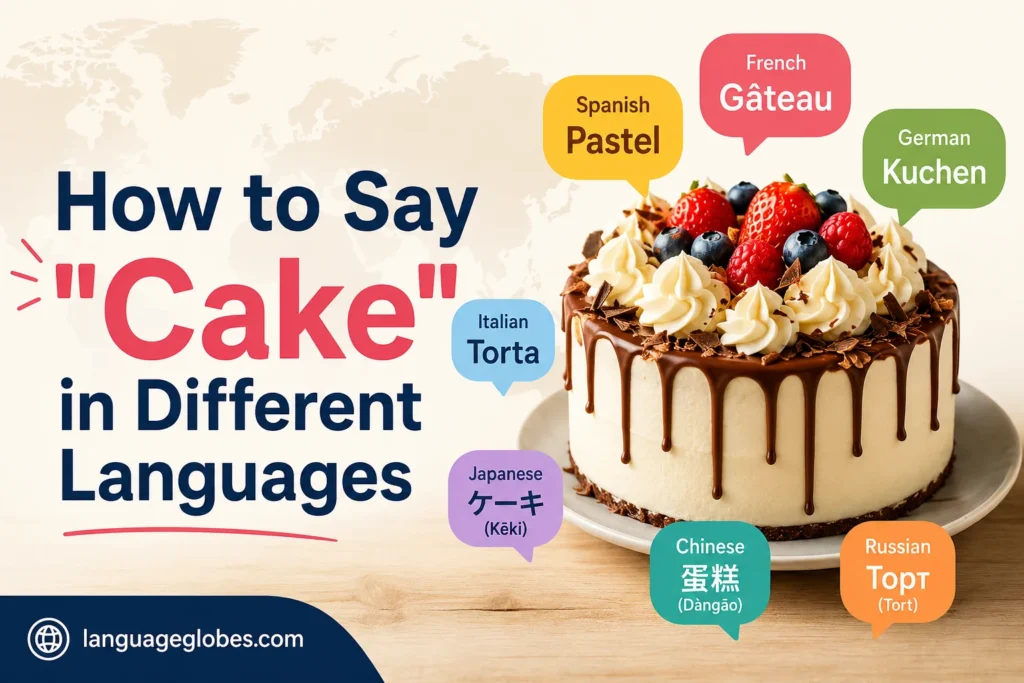
Learning How to Say “Cake” in Different Languages reveals how language, cultures, people and celebrations connect worldwide daily.
During my culinary travels, I noticed how language acts as a bridge that connects people from different cultures in the most natural way. A simple word like cake can express warmth, friendship and celebration during international gatherings, a birthday, a wedding or a simple gathering. In every region of the globe, this delightful dessert holds a central role in festive occasions because it remains a universally cherished symbol of joy, togetherness, happiness and universal love. The essence of cakes stays constant, but the translation, pronunciation and vocabulary connected to it varies significantly across different languages and multilingual communities.
Exploring Cake Names Around the World
This article helps readers explore translations of cake in 70 languages, carefully categorized with easy pronunciation guides and useful example sentences. The exploration becomes a fascinating journey through worldwide food traditions where food, dessert culture and cultural identity naturally come together. Every language, from local dialects to major international tongues, carries unique cultural nuances, traditions and expressions that display the richness of human communication. I personally appreciate the small nuances hidden in these simple phrases because they improve our understanding of heritage and daily life.
The Cultural Meaning of Cake
This linguistic journey of discovering cake names around the world shows how one sweet treat transcends borders and generations. These languages not only represent sweetness and celebration, but also preserve heritage and family memories shared during special moments. From traditional recipes to modern desserts, cakes continue to unite families and friends through shared meals and meaningful celebrations. This global tour of showcasing cake-related translations reflects how deeply diversity, culture, human connection and communication remain connected around the world.
Interesting Facts About How to Say The Cake
- Cake has been a part of human celebration for centuries, from ancient Egyptian honey cakes to modern layered cakes.
- The word for “cake” varies greatly across languages, reflecting local ingredients and baking traditions.
- In some cultures, cakes are more symbolic than edible, representing prosperity, good luck, or spiritual offerings.
- Mastering food vocabulary can make traveling and cultural immersion more enjoyable and respectful.
European Languages
Europe is home to a vast array of languages, each with its unique way of referring to food and celebrations. From the romantic sounds of Italian to the precise tones of German, knowing how to say “the cake” in these languages can enhance culinary experiences across the continent.
| Language | Country/Region | Translation | Pronunciation | Example Sentence |
| English (American) 🇺🇸 | USA | The cake | thuh keɪk | I baked the cake for your birthday. |
| English (British) 🇬🇧 | UK | The cake | thuh keɪk | She decorated the cake beautifully. |
| English (Australian) 🇦🇺 | Australia | The cake | thuh keɪk | Let’s eat the cake now! |
| French 🇫🇷 | France | Le gâteau | luh gah-toh | J’ai préparé le gâteau pour la fête. (I prepared the cake for the party.) |
| Spanish 🇪🇸 | Spain | El pastel | el pas-tel | El pastel es delicioso. (The cake is delicious.) |
| Italian 🇮🇹 | Italy | La torta | lah tor-tah | La torta è pronta. (The cake is ready.) |
| German 🇩🇪 | Germany | Der Kuchen | der koo-khen | Ich habe den Kuchen gebacken. (I baked the cake.) |
| Portuguese 🇵🇹 | Portugal | O bolo | oo bo-lo | O bolo está delicioso. (The cake is delicious.) |
| Dutch 🇳🇱 | Netherlands | De taart | duh taart | De taart is klaar. (The cake is ready.) |
| Swedish 🇸🇪 | Sweden | Kakan | kah-kan | Kakan är färdig. (The cake is ready.) |
Asian Languages
Asia is rich with languages that reflect centuries of culinary tradition. Cakes, often influenced by Western desserts or traditional sweets, have unique names in different Asian languages.
| Language | Country/Region | Translation | Pronunciation | Example Sentence |
| Chinese (Mandarin) 🇨🇳 | China | 蛋糕 | dàn gāo | 我做了蛋糕给你。 (I made the cake for you.) |
| Japanese 🇯🇵 | Japan | ケーキ | kēki | 誕生日のためにケーキを作りました。 (I made a cake for the birthday.) |
| Korean 🇰🇷 | South Korea | 케이크 | keikeu | 생일 케이크를 준비했어요. (I prepared the birthday cake.) |
| Hindi 🇮🇳 | India | केक | kek | मैंने केक बनाया। (I made the cake.) |
| Arabic (Gulf) 🇦🇪 | UAE | الكعكة | al-ka‘ka | لقد صنعت الكعكة للحفل. (I made the cake for the party.) |
| Thai 🇹🇭 | Thailand | เค้ก | kêk | ฉันทำเค้กสำหรับคุณ (I made the cake for you.) |
| Vietnamese 🇻🇳 | Vietnam | Chiếc bánh | chee-ehk banh | Tôi làm chiếc bánh này cho bạn. (I made this cake for you.) |
| Turkish 🇹🇷 | Turkey | Pasta | pas-tah | Pastayı ben yaptım. (I made the cake.) |
| Indonesian 🇮🇩 | Indonesia | Kue | koo-eh | Saya membuat kue untukmu. (I made a cake for you.) |
| Filipino 🇵🇭 | Philippines | Keyk | kayk | Gumawa ako ng keyk para sa iyo. (I made a cake for you.) |
African Languages
Africa’s linguistic diversity is immense, with over 2,000 languages. Traditional and modern cakes are often referred to differently depending on local languages and colonial influences.
| Language | Country/Region | Translation | Pronunciation | Example Sentence |
| Swahili 🇰🇪 | Kenya | Keki | keh-kee | Nimepika keki kwa ajili yako. (I baked the cake for you.) |
| Zulu 🇿🇦 | South Africa | Ikhekhe | ee-kheh-kheh | Ngiphekile ikhekhe lakho. (I baked your cake.) |
| Amharic 🇪🇹 | Ethiopia | ኬክ | kek | ኬኩን ለአንተ አዘጋጅቻለሁ። (I prepared the cake for you.) |
| Arabic (North Africa) 🇲🇦 | Morocco | الكعكة | al-ka‘ka | حضرت الكعكة للاحتفال. (I prepared the cake for the celebration.) |
| Hausa 🇳🇬 | Nigeria | Kek | kek | Na yi kek din. (I made the cake.) |
| Yoruba 🇳🇬 | Nigeria | Kek | kek | Mo ti se kek fun o. (I made the cake for you.) |
| Somali 🇸🇴 | Somalia | Keeg | keeg | Waxaan diyaariyey keegga. (I prepared the cake.) |
| Malagasy 🇲🇬 | Madagascar | Mofo | mo-fo | Namorona mofo ho anao aho. (I made bread/cake for you.) |
| Shona 🇿🇼 | Zimbabwe | Keki | keh-kee | Ndakabika keki yako. (I baked your cake.) |
| Arabic (Egypt) 🇪🇬 | Egypt | الكيكة | al-kee-kah | صنعت الكيكة من أجلك. (I made the cake for you.) |
Read More: How to Say “Calm” in Different Languages
Middle Eastern Languages
The Middle East has a rich tradition of sweet pastries and cakes. Understanding how to refer to cakes in local languages shows cultural respect and can enhance culinary experiences.
| Language | Country/Region | Translation | Pronunciation | Example Sentence |
| Arabic (Levant) 🇱🇧 | Lebanon | الكعكة | al-ka‘ka | حضرت الكعكة للحفل. (I prepared the cake for the celebration.) |
| Persian 🇮🇷 | Iran | کیک | keik | کیک را برایت درست کردم. (I made the cake for you.) |
| Hebrew 🇮🇱 | Israel | העוגה | ha-uga | הכנתי את העוגה עבורך. (I made the cake for you.) |
| Kurdish 🇹🇯 | Iraq | Keik | keik | Ez keik ji bo te amade kirim. (I prepared the cake for you.) |
| Turkish 🇹🇷 | Turkey | Pasta | pas-tah | Pastayı ben yaptım. (I made the cake.) |
| Arabic (Saudi) 🇸🇦 | Saudi Arabia | الكعكة | al-ka‘ka | صنعت الكعكة للاحتفال. (I made the cake for the celebration.) |
| Arabic (Oman) 🇴🇲 | Oman | الكعكة | al-ka‘ka | حضرت الكعكة للمناسبة. (I prepared the cake for the occasion.) |
| Arabic (Qatar) 🇶🇦 | Qatar | الكعكة | al-ka‘ka | صنعت الكعكة لك. (I made the cake for you.) |
| Arabic (Bahrain) 🇧🇭 | Bahrain | الكعكة | al-ka‘ka | حضّرت الكعكة للاحتفال. (I prepared the cake for the celebration.) |
| Arabic (Jordan) 🇯🇴 | Jordan | الكعكة | al-ka‘ka | حضرت الكعكة للعيد. (I prepared the cake for the holiday.) |
FAQs
1. Why do people search for how to say “cake” in different languages?
People enjoy learning cake translations because food and language help connect cultures and make communication more fun during travel and celebrations.
2. How many languages have unique words for cake?
Almost every language has its own word for cake, and many cultures also have regional variations and traditional dessert names.
3. Is cake considered a universal symbol of celebration?
Yes, cake is widely seen as a symbol of joy, happiness, birthdays, weddings, and festive occasions around the world.
4. Why does the pronunciation of cake-related words differ across languages?
Each language has its own pronunciation rules, sounds and vocabulary traditions, which create different ways of saying the same word.
5. Can learning food words improve language skills?
Yes, learning simple food-related words like cake helps improve vocabulary, pronunciation, cultural understanding and everyday communication.
6. Which cultures are most famous for traditional cakes?
Many cultures are known for famous cakes, including French, German, Italian, Japanese, Turkish and Middle Eastern dessert traditions.
7. Are cake translations useful for travelers?
Yes, travelers often use cake translations in bakeries, restaurants, celebrations and international gatherings while exploring new countries.
8. Why is cake important in cultural identity?
Cake reflects local traditions, heritage, family customs and festive celebrations that are passed from one generation to another.
9. Do some languages use the same word for cake?
Yes, some languages share similar cake-related words because of historical influence, trade and cultural exchange.
10. What can we learn from cake names in different languages?
Cake names reveal cultural nuances, linguistic diversity, dessert traditions and the universal love people share for sweet treats.
Conclusion
Learning how to say “the cake” in different languages is more than just memorizing words—it is about connecting with people and cultures around the world. Food is a universal language of love and celebration, and mastering its vocabulary allows for deeper experiences while traveling, cooking, or sharing stories. Whether you say “le gâteau” in French, “ケーキ” in Japanese, or “الكعكة” in Arabic, the joy of cake remains universal, bridging cultures one slice at a time.
Exploring these phrases also encourages curiosity about language and culture, reminding us that even simple words can carry rich meanings and connections.

Joshua Lewis is a passionate language enthusiast and content creator at LanguageGlobes.com. He specializes in exploring global languages, cultures, and communication trends, helping readers connect with the world through words.